Friday, November 29, 2013

The Public Alhambra: Fatima's Perspective - Part II

What would it be like to have certainty or even the smallest inkling that your sibling had murdered your beloved parent? It was the dilemma my heroine Fatima faced in 1302 when her father Muhammad II died suddenly. In Sultana's Legacy, Fatima seeks vengeance for her cruel loss, but in reality I have no idea how she reacted. The fact that her husband Faraj took the pragmatic approach and continued to enjoy good relations with his brother in-law doesn't tell me anything other than how he might have kept a level head so he could also hold on to the governorship of Malaga. With her murderous brother now in charge, the world around Fatima would have been rapidly altered.

"Psychotic" or "sociopath" are the terms that come to mind when I consider Muhammad III. Sometimes it's hard to believe he and Fatima were full-blooded siblings, but they shared several traits in their interests in learning and patronage of the arts. So what turned them in two different directions, allowing Fatima to become the devoted matriarch of the Nasrid Dynasty and making Muhammad III into a vicious killer?

The saying, "there's one in every bunch" is exemplified in Muhammad III. Of all the Nasrids, who could be quite cruel when they wanted, he stands out. One of my "favorite" stories of him is about how he treated the servants of his father, whom he had arrested, likely because they knew something about the role of the poisoned cake that had come from Muhammad III's house and led to the pain-filled death of Muhammad II. The warden took pity on the prisoners thrown into a dank hole at Alcazaba and threw down some bread to them. When Muhammad III found out, he had the jailor's head cut off and let the blood drip down on the condemned so "they could have something to drink." Doesn't get any crazier than that.

Of Muhammad III, the best that can be said of him is that he is responsible for Alhambra's mosque, which is now the St. Mary Church at Alhambra, and the bath attached to the mosque, as well as the area known as the Partal, an extension of his father's palace on the higher ground. The lantern of the mosque is in Charles V's palace. Like many of the members of his family who contributed to the grandeur of Alhambra, Muhammad III was an adherent of Islam. While he had access to the oratories in the Mexuar or the precursor of the Compares tower, the mosque allowed the denizens of the royal city a place where they could worship. The bath house fulfilled the ritual washing requirement.

The bath, as with many other areas of Alhambra, shows its age and cannot have accommodated many people at one time. The private bath of the royal family, entered through the Court of Myrtles or later, the Court of Lions makes it unlikely that Muhammad III, Fatima or any member of their households would have used the place. Still, the rulers of Granada never fully insulated themselves from the public. Fatima's great-grandson, Muhammad V, was known to ride through the streets at times unattended. His father Yusuf I was received with so much acclaim in Gaudix in 1352, the women of the town who would have normally veiled themselves, took off their veils to greet him. Unfortunately, the Nasrids often had more to fear from each other than any outsider, as Fatima must have discovered to her horror.

This is my last entry on the public face of Alhambra. Soon I'll have more on the private areas and post some of over 1,000 pictures taken on this latest trip within and outside Alhambra on my Facebook page.

Have a great weekend!

Thursday, November 28, 2013

The Public Alhambra: Comares Palace - Yusuf I & Muhammad V

While touring Alhambra, I met a nice couple from Greenwich and we fell to talking about this amazing monument. The wife asked who built Alhambra. That’s not such an easy question to answer, but I did explain how various rulers ordered construction on certain parts, later adapted or altered by their descendants. The Comares tower is one example. What we see today is the influence of two of the major rulers from the 14th century; Yusuf I, my hero in Sultana: Two Sisters, and his son with Butayna, Muhammad V.


There has always been a bastion at this particular spot of Alhambra, from perhaps even before the rule of Fatima’s grandfather, Muhammad I. Several scenes in the series take place in this hall; the return of Muhammad I’s body to Granada and the ascendancy of Muhammad II in Sultana; Fatima’s confrontation with her murderous, full-blood brother Muhammad III after the sudden demise of their father in Sultana’s Legacy; Yusuf I’s meeting with the rebel Marinid princes in Sultana: Two Sisters. The Comares tower became a likely backdrop for several momentous events in Alhambra and Granada’s history.


That the Comares tower definitively served as the throne room of Fatima’s relations comes from a poem inscribed within the central, north-facing alcove of the hall. The verses name the ruler in whose name the tower was built as Yusuf I and as such, either his chief minister Ali ibn al-Jayyab or that man’s successor, Ibn al-Khatib composed the words. They refer to the nine alcoves in the room as a group of constellations, with the central alcove as the most important because the monarch sat there:

“…My lord Yusuf, sustained by God, clothed me in dignity with robes of undeniable distinction, making me the throne of the kingdom (kursi mulk), the grandeur of which is born up thanks to the Light, the Seat and the Throne.”


Before entering the Comares tower at the north, there is a shaded arcade of eight pillars beneath arches, mirrored at the south end of the Court of Myrtles. Next is a hall referred to as Sala de Barca, for its boat-shaped ceiling. Muhammad V ordered its construction as an extension of the Comares hall, possibly dating to as late as 1367 because after that year, all further expansion at Alhambra in his reign bears the regal name he adopted after the Granadine recapture of Algeciras (al-Jazirah al-Khadra), al-Ghani bi-Llah, which means ‘he is who is satisfied by God.’ Fire destroyed the original ceiling in 1890.

I love the hidden spaces of Alhambra – actually, not really, since the authenticity of my series would be better if I could see everything – and the Comares hall obliges by having two doors, one leading up into the tower and another for the ruler’s private oratory. The imagination can run wild in this place, wondering about the intrigues that unfolded in the throne room.

Muhammad V finished the work his father Yusuf I started on the Comares hall. Light streams into the room through the lattice in each alcove, illuminating a 16th century terracotta floor. At its center are ceramic tiles glazed in gold, blue and white. In the days of the Nasrid sovereigns, no one crossed this space because the 99 names of God in Arabic were inscribed here. I assume this significance is part of why the original floor is missing.


Since the rooms to the south were destroyed by Charles V, speculation also remains about what lay behind the façade. Was the space reserved for foreign dignitaries during their visits to Alhambra? Did the important ministers like Ali ibn al-Jayyab, Ibn al-Khatib or Muhammad’s faithful boyhood tutor Ridwan have rooms there? In Sultana: Two Sisters, I described the upper floors as being part of an extension of the harem, placing Butayna and Maryam’s chambers in the south end of the Court of Myrtles. I imagined them peering through the latticework at events unfolding outside the throne room. The likely position of the harem seems too small to have accommodated the rulers and their families over generations. Also, the modern access at the south end from the Court of Myrtles to Muhammad’s crowning achievement, the Court of Lions, did not exist during Nasrid rule. The Catholic Monarchs linked those two areas.


Next, I’ll wrap up with the last public space visitors can still see, the baths attached to what was once the great mosque of Alhambra, built by Fatima’s brother Muhammad III. I had hoped to also show pictures of the royal graveyard (rawda) where some of the monarchs like Muhammad II, his grandson from Fatima, Ismail I and Ismail’s son Yusuf I, were interred along with their illustrious matriarch, Fatima, but it appears conservation efforts are underway. I was fortunate to see some of the gravesites in an earlier visit. No bodies lie there. When the Nasrids lost Granada forever in 1492, they took the bones of their ancestors out of Alhambra. They may have reinterred them at Mondujar, where the last Sultana, Moraima, was buried. The gravestone of Muhammad II is in the Alhambra Museum in Charles V’s rotunda.

When I’m back in New York, I’ll share more about Alhambra, the private world of the Nasrid bath, harem and the summer palace.   


Happy Thanksgiving if you’re celebrating in the US.

Wednesday, November 27, 2013

The Public Alhambra: Muhammad V's Contributions - Part II

I haven’t found any reference for the name the Moors once gave the open-air courtyard of the Golden Chamber in Alhambra. The name derives from the 1499 gilded restoration of the room. A different passageway existed in Fatima’s time, possibly evidenced by an eastern-oriented doorway from the Mexuar. Many theorize that ambassadors and other dignitaries waited in the chamber to meet with the rulers of Granada. Of all the most common inscriptions incised along the walls of the Golden Chamber, this one is most repeated: “Victory only comes with God, the Powerful, the Wise,” a verse from the Qur’an.

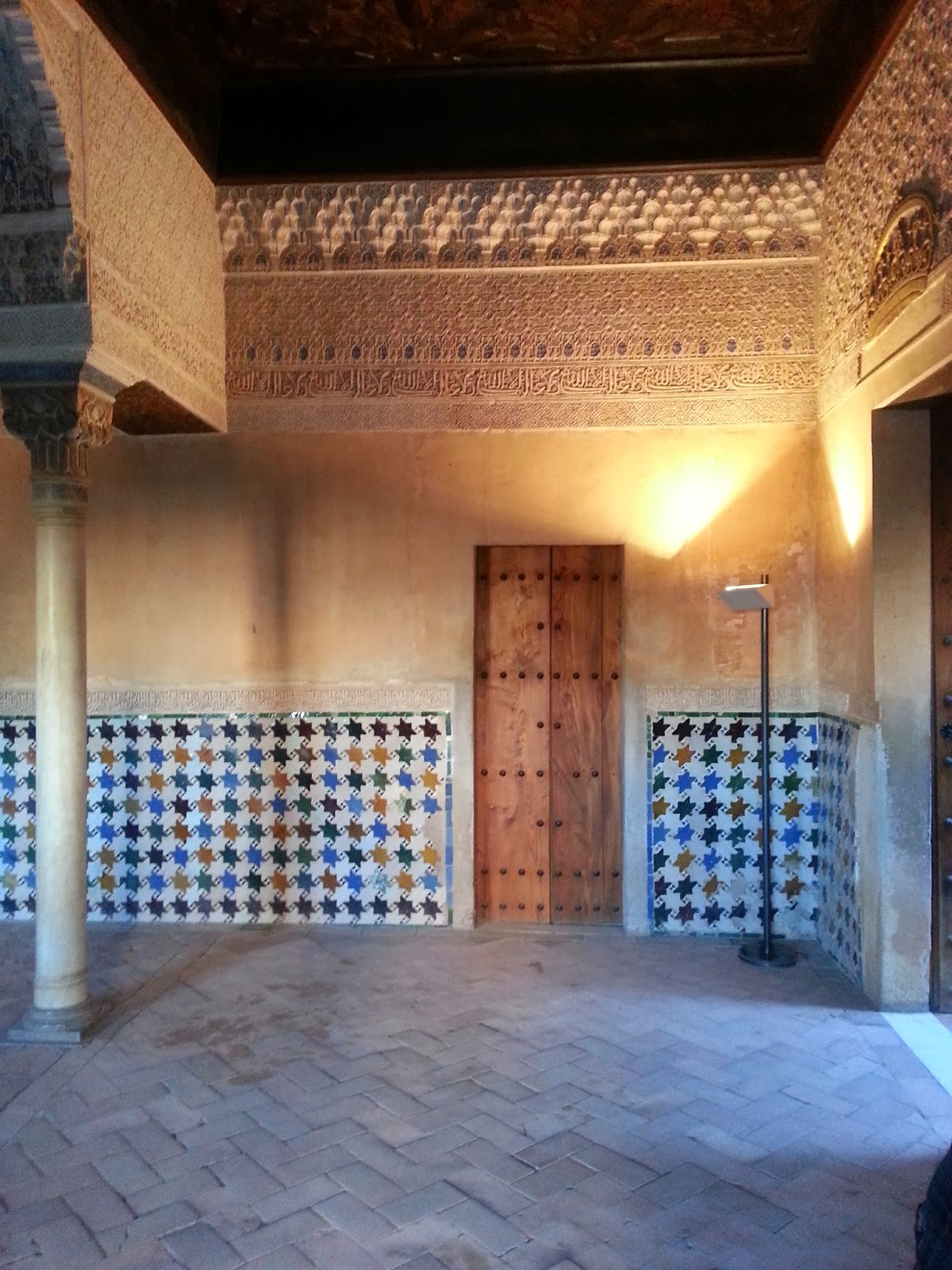
Muhammad V undertook some of the work evident in the hall between 1367 and 1369, to commemorate prominent victories over his enemies at cities like Jaen (Jayyan), Baeza (Bastah) and most importantly, Algeciras (al-Jazirah al-Khadra). In Moorish times, three windows rather than a central, north-facing one overlooked the city. Medieval visitors would have enjoyed an incredible view of the neighborhood of Albaicin (Al-Bayazin). To the south, the façade indicates two doors, but only one has ever been open to the public. On either side of the doors, a blessing is incised along with carved shells and pine cones. There are latticework windows above, which indicate an upper floor removed by the Catholic Monarchs. Through the Golden Chamber’s open door at the south, visitors enter the façade of the Comares palace via a right-angled corridor with arched alcoves.

I don’t why this section is called the Comares; there was a fortress-city at Qumarich held first by the Ashqilula clan, one- time allies of the Nasrids until Fatima married her paternal cousin Faraj in 1266. Fatima’s father regained Qumarich when he exiled his Ashqilula enemies, but I can’t think of any significance the territory held afterward. The name could also derive from Qamriyya for the stained glass windows, which once existed in the Comares tower, or from Qum`arsh, an Arabic term for “room or seat of the throne.” Whatever the source, Comares is one of the most spectacular spaces in an already stunning place.

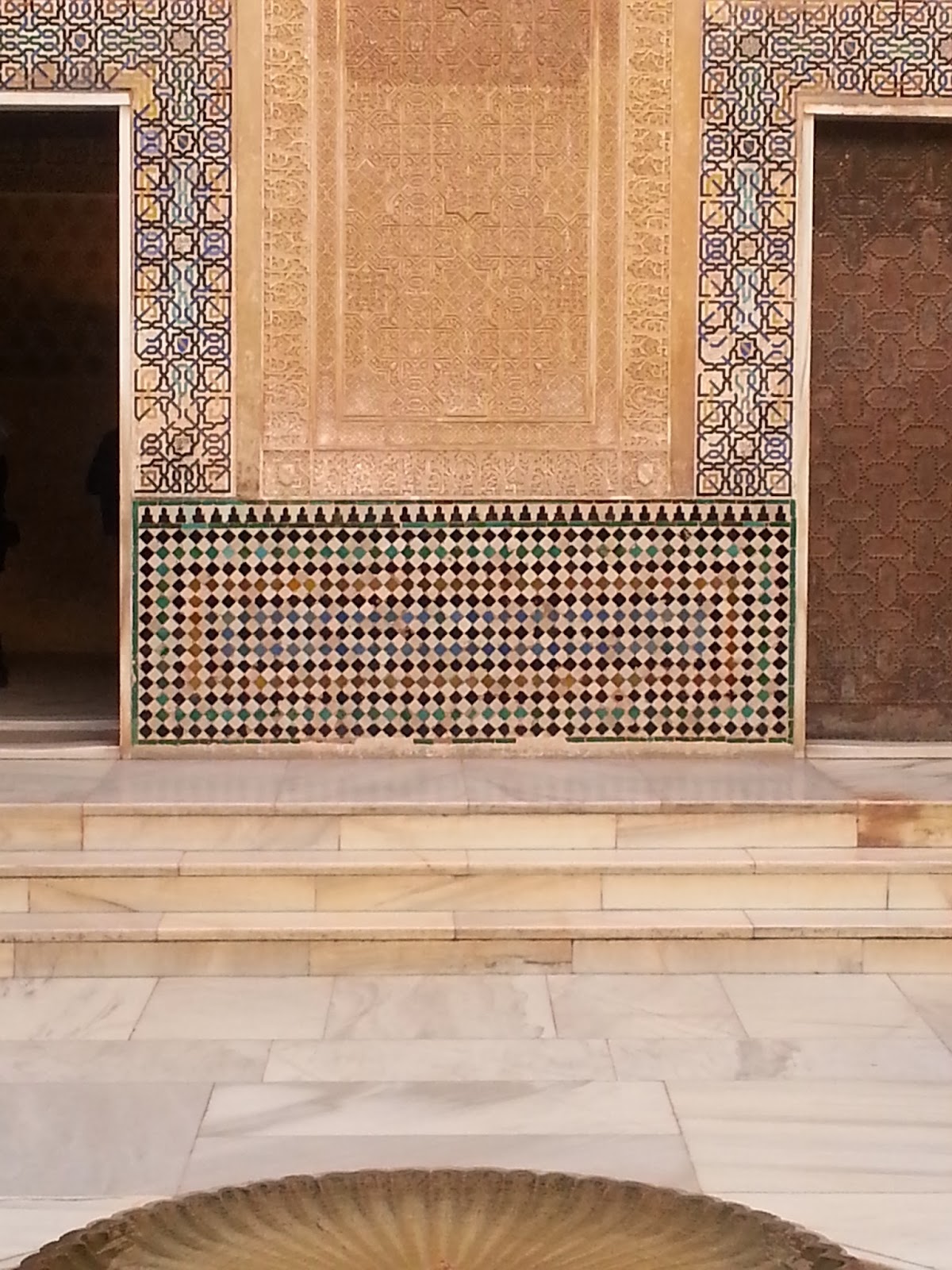
At its center is the Courtyard of the Myrtles. At the north the Comares tower remains, but to the south the 1537 Palace of Charles V obliterated any rooms behind the façade. The southern portico has a central door forever closed and two more at the adjoining east and west walls, all topped by a row of eight windows covered by lattice and columns joined by arches above. There is a pool bordered by two series of myrtle bushes. The courtyard likely existed in Fatima’s time, but her grandson Yusuf I, father of Muhammad V, made changes that were not completed before Yusuf’s untimely death in 1354. Muhammad V finished his father’s restoration by 1370. On its eastern side, latticed windows front the courtyard and one door leads to the bathhouse built by Fatima’s son Ismail I. The western wall is its mirror image; through the southernmost door fitted along it, visitors can glimpse the path to the Mexuar that serves as the modern entrance. There are arched alcoves along both walls, some of which give access to other restricted parts of the palace. A poem composed by Ibn Zamrak, one of the ministers of Muhammad V described the courtyard:

“I am like a maidservant whose betrothed desire each other and to whom a crown and diadem have already been given; before me is the mirror, a pool upon whose surface my beauty takes shape.”
More on the Comares tower in the next post.

Tuesday, November 26, 2013

The Public Alhambra: Muhammad V's Contributions - Part I

Hola from cold but beautiful Granada and its famous Alhambra. I’m taking a much-needed break and enjoying my favorite place, which allows for the continuation of my post from last month about the complex as the characters of the Sultana series would have known it. Evidence of restoration is everywhere in Alhambra today, all geared towards the preservation of this beautiful monument. As a result, crowd control has also become stricter, but even this couldn’t lessen my enjoyment. It is a little sad to see some of the further deterioration that Alhambra has undergone since I first visited exactly 12 years ago this week, but the site remains inspirational. This morning as I walked down and up the Sabika hill again, two things struck me. One, medieval Moors must have been in incredible shape, because that hill is a killer, or they had very sure-footed horses. Two, the extensive view of the Granadine plain afforded a natural vantage point for the location of Alhambra and ensured its defense for almost seven centuries.

I spent more time than I ever have in the past within the Mexuar (mashwar in the series) begun by Fatima’s father, Muhammad II in Sultana. Most of the tours had moved through and made it easier to take pictures. Warning: if you’re planning a visit to Alhambra any time soon, the morning tours make it almost impossible to get a shot anywhere without crowds moving through the space.  Try after 12pm. The Mexuar of today reflects the period of Fatima’s great-grandson Muhammad V, the hero of my next, Sultana: The Bride Price. Fatima did not live long enough to witness his ascendancy. During his extensive reign, Muhammad V had the opportunity to shape what we see. From the entryway with its 1362 frieze styled in Nashki cursive script to the poetry along the walls speaks of the majesty of one of the most illustrious sultans of the Nasrid Dynasty. I can’t go into why Muhammad V altered so much of his ancestors’ palace complex without ruining the plot of The Bride Price, but let’s just say he had great reason to celebrate and revitalize the site.
 
It is impossible to know how much alteration Muhammad V made to the chamber as it might have stood during the reign of his great-great grandfather Muhammad II. The differences between Moorish and Christian influences within the space can be found in the addition of the emblems of the Catholic Monarchs Isabella and Ferdinand to start. In Moorish times, the Mexuar’s floor was at a different height and there were two windows, with a central doorway and another facing west towards the citadel at Alcazaba, not four barred windows. At first glance it would appear as if the upper walls are stark, but closer observance reveals traces of blue and green pigments. Color is everywhere in Alhambra, especially where you least expect it. Unfortunately most of the luxurious tile work and the lantern lighting the cupola between the four pillars of the chamber are gone. In this room I imagined a scene of Sultana might have taken place, where Fatima’s husband Faraj received the governorship of Malaga (Malaka). A poem once adorned the walls of the Mexuar at the direction of Muhammad’s minister Ibn al-Khatib:

“…Muhammad, son of Abu l-Hajjaj (Sultan Yusuf I) built me, and thus is worthy of the truest and most genuine praise.
It is he whose skill – blessed be he – unites with constancy two opponents: generosity and courage...." 
From the Mexuar and its oratory, also redesigned by Muhammad V between 1363 and 1367, an open arch leads to an open space now called the Golden Chamber with its adjoining portico facing north of Alhambra. More on that tomorrow, as uploads of the pictures are painfully slow here. 

Friday, November 8, 2013

Sultana's featured today at The Fussy Librarian

The Fussy Librarian
Historical fiction | Fiction
Servant of the Gods by Valerie Douglas
$3.99Average Rating: 4.3 out of 15 reviews.
Buy Now:
Orphaned as a child, Irisi became a mercenary to survive. Captured by the Egyptian army and made the spoils of war, she finds herself forced to fight in the ring for entertainment. In a desperate attempt to regain her freedom she throws herself on the mercy of the Gods, only to discover that her fate is written in prophecy...
 
The Fussy Librarian
 
Historical fiction | Fiction
Sultana: A Novel of Moorish Spain by Lisa J. Yarde
$3.82Average Rating: 4.0 out of 67 reviews.
Buy Now:
   
Book #1 of the Sultana series. In thirteenth-century Moorish Spain, the realm of Granada is in crisis. The union of Fatima, granddaughter of the Sultan of Granada, with the Sultan’s nephew Faraj has fractured the nation. A bitter civil war escalates and endangers both Fatima and Faraj’s lives. All her life, Fatima has sheltered in lavish palaces where danger has never intruded, until now. A precocious child and the unwitting pawn of her family, she learns how her marriage may determine her future and the fate of Granada. Her husband Faraj has his own qualms about their union. At a young age, he witnessed the deaths of his parents, and discovered how affluence and power gives little protection against indomitable enemies.
 
The Fussy Librarian
 
Romance-historical | Fiction
My Highland Love by Tarah Scott
$3.99Average Rating: 4.4 out of 28 reviews.
Buy Now:
 
How does a woman explain to her betrothed that she murdered her first husband? Shipwrecked in the Scottish Highlands, American heiress Elise Kingston quietly plans revenge for the deaths of her daughter and the brother who sacrificed his life to save her. When Marcus MacGregor, Marquess of Ashlund, returns to his Highland home to discover a stunning American woman has been taken in by his clan, his attraction is instant and he resolves to make her his -- no matter what secret she's keeping. Elise is shocked by her need for Marcus and, too late, discovers that her feelings make him a target of her enemy -- a man powerful enough to destroy even a Scottish nobleman. This is a second edition. First Edition published by Silver Publishing.
 
The Fussy Librarian
 
Romance-historical | Fiction
The Virtuous Ward by Karla Darcy
$4.99Average Rating: 4.5 out of 43 reviews.
Buy Now:
  
If you love Downton Abbey and Jane Austen you’ll love The Virtuous Ward! This is book #5 in the Sweet Deception Regency series that brings you the adventures of the gentlemen of the ton who are members of Sweet’s Racing Club and the women they love. Lord Maxwell Kampford has kept his ward in seclusion but now must sponsor her in society in order to marry her off. Unsophisticated and trusting, Amity is set up by Max's jealous fiancée to fail. Max is confounded by the loyalties of the girl who seems to champion every orphaned and abused animal and turns his bachelor household upside down. Will he discover love or let this charmer get away?

Thursday, October 10, 2013

The Public Alhambra: Fatima's Perspective in Sultana - Part I

The Sultana series introduces readers to the real-life Moorish heroine Fatima, her husband Faraj and the rest of their family, all members of  the Nasrid clan, the last native Muslim dynasty in Spain. Sheltered from her youth within Granada's Alhambra (al-Qal’at al-Hamra), Fatima married Faraj, a paternal first cousin to her father Muhammad II in 1266 when she was between the ages of eight and twelve. Faraj was ten years older than his young wife. She died in her early nineties on February 26, 1349. Her husband preceded her in death some twenty years before, in February 1320. During Fatima's long years, she would have witnessed alterations to the complex of palaces, barracks, industrial and commercial quarters, mosques and baths at Alhambra. Although raised as a princess within the harem, Fatima did not remain hidden behind those walls. She would been familiar with all parts of the public domain her grandfather, father, brothers, son and grandsons ruled. From the dank, lowliest dungeon in Alcazaba to the delicate beauty of the summer palace at Alhambra, the Generalife, Fatima would have seen it all.


From the time her paternal grandfather Muhammad I occupied the site of Alhambra in 1237, thirteenth-century visitors and occupants of the site would have entered and left through its main medieval gate, along a course no visitors to Alhambra can see today. Referred to as the Puerta de Las Armas today, the precursor of this gate rose above what is now a neglected cobblestone path, permanently closed to all except Alhambra researchers. The route would have granted access to the complex for visitors from the north via a bridge over the Darro (Hadarro) river, and from the west up a hill, which the Moors called the Sabika. The gate connected with one of the oldest parts of Alhambra, its Alcazaba (al-Quasaba), which has existed since at least the ninth century during the first two centuries of Moorish rule over southern Spain.

As the most fully excavated portion of the complex, Alcazaba was the citadel of Alhambra, where the barracks of the officers and sentries existed in the shadow of a watchtower Fatima's grandfather built, the Torre de la Vela. This squat tower affords one of the best views of Granada, if you're willing to undertake a climb up the spiral stair inside to reach the top. Alcazaba was a construction of the Zirid period in Granada, during which Muslim rulers and their Jewish viziers developed the foundations of the citadel Fatima would have been familiar with in her lifetime. During his forty-year reign, Muhammad I enlarged Alcazaba by adding the Torre de la Vela. He provided water access for his men via a canal into which the Darro flowed. Water allowed for the addition of a cistern and bath. More than soldiers lived at the barracks of Alcazaba. The foundations of the excavated buildings indicate they would have accommodated families. But this is was not just a location where Granadine warriors gathered with their wives and children, enjoying meals and music beneath the stars at the end of a long day.


At the western end of Alcazaba, at the base of the Torre de la Vela, the sultans held their prisoners; captives for ransom and subjects who had fallen into disfavor. Unfortunates consigned to the cell descended via a ladder into a conical-shaped room with a trapdoor that left them no means of escape. Fatima would have been unable to escape their cries. In later years, when her full-blood brother Muhammad III poisoned their father and threw the man's servants into this dungeon, a warden took pity on them and offered the occupants some bread. When Muhammad III found out, he had the warden's head cut off and ordered it held over the trapdoor, dripping blood on to the prisoners, so that they could "have something to drink" in his words. During Muhammad III's reign, he also resided on the second storey of the Torre de la Vela at times.

Moving from the west, in the thirteenth-century a makeshift marketplace bounded by a precinct wall and a small ravine separated Alcazaba from the administrative areas of Alhambra. The northern boundary wall allowed visitors and residents to pass from this space, but it's impossible to know the thirteenth-century version of what preceded the sixteenth-century Patio de Machuca, which now occupies the west of the so-called Mexuar, or council area. Part of the reason some think the Mexuar was the council chamber likely comes from one tile in the room, which reads "Do not be afraid to ask for justice, for you will find it." Today, this space is where most visitors to Alhambra are invited to enter the palace. It's believed the foundations of a ministerial body developed during the reign of Fatima's father Muhammad II, perhaps prompted by what he had seen of the Castilian rudimentary parliament, the Cortes, during a visit to Seville in  December 1273. His council, the Diwan al-Insha, included some of the most preeminent men of Granada who served as secretaries, and heads of departments. A thirteenth-century lantern of stained glass once caught the sunlight filtering into this room. North of the Mexuar is a room designated as an oratory, retaining a wall inscription, "Do not be negligent. Come to prayer." The oratory opens up to a northwestern view of the Darro and the Albaicin neighborhood  known from Moorish times as al-Bayazin.

Later, I'll have more the public spaces Fatima would have been familiar with from the reign of her father, including what is now called the Hall of Ambassadors and the Court of Myrtles, the Partal buildings from the time of brother Muhammad III, the towers of her half-sibling Nasr I and the summer palace her son Ismail I built on an incline overlooking Alhambra.

For more, check out this virtual walking tour of Alhambra from Saudi Aramaco World.

Wednesday, July 31, 2013

Promoting and selling ebooks with Ganxy

Visitors to my author website will notice a change on the page where books can be bought. I'm using Ganxy to facilitate the delivery of ebooks to readers who want to buy direct from me (at a discount) and I'm providing links to major retailers. If you're looking for a simple, easy to use interface for delivery of digital content, Ganxy is a great tool.

To get started, use the link above or go to http://get.ganxy.com/ to set up an account. You have the option to create an account with your email address and password, or sign up through Facebook or SoundCloud. Personally, I prefer the first approach - you never know when FB may tick you off and make you want to delete your account! (That would be another blog post, for another day.)

At Ganxy, you have the option to create two types of campaigns; to sell direct and provide access to retailers or set up time-limited giveaways. I'll be trying the second feature with Sultana: Two Sisters when it's available this winter. There are minimal costs involved with both approaches. If you're selling through Ganxy, you'll receive 90% of the revenue directed to a PayPal account. Note; PayPal charges additional fees for non-US account holders. For giveaways, there's a small fee as well; details to follow in a future blog post.


Step 1: To get started with sales, click on "Sell Directly and Generate Sales" and setup your ebook, adding the title name, author and description. At any stage, you can preview the process.

Step 2: Next, you have the option to sell directly and list retailers who are already selling your content. All the major retailers are there: Apple, Audible, CreateSpace, Kobo, Sony, Smashwords, Walmart, Target, Barnes and Noble (who knows for how long), and of course, Amazon.com and Amazon UK. On Amazon, since there are now multiple sites beyond the US and UK areas, I tried to use my Viewbook.at links (which routes interested buyers to their particular Amazon regional store) only to discovery that Booklinker is now  in charge of this site. Hmm. Will muddle through all that later. I'll update this post if the Viewbook now Booklinker URL's work. 

You can also specify the format(s) offered at each retailer; ebook / print / ebook and print or audiobook. So I've specified On Falcon's Wings as being available as an audiobook through Audible and as an ebook and print from Amazon.com. One issue I found was that every retailer through whom I currently sell books isn't indicated. For instance, my ebooks are available online through Casa del Libro, one of Spain's chain bookstores, but I'd need to have Ganxy approve the link.

On selling your own work, you must provide the formatted files yourself; Ganxy does not offer conversion services. Upload your own DRM-free mobi, ePub or PDF files. Ganxy will review these files before you're allowed to sell directly. If you do want to provide your content for direct sale, be sure to indicate the price. You do not have to enable the direct sales feature; if you want to use Ganxy just to provide links to retailers, no problem.

For each ebook, you also have the option to include social media links to post your showcased work on Facebook, Twitter, Pinterest, and Google +, AND visitors can subscribe to receive emails from you. I'm using MailChimp already, so I'm not sure about that last bit.

Step 3: Almost done! Now add your ebook cover image (JPEGs and PNGs only) up to 2MBs, any excerpt and YouTube book trailer. Click Finish to share your content via social media or embed it on a website.

Edited to add: Best of all, make ANY updates to your Ganxy product and the changes will appear on your website without you having to reformat anything on the webpage.

What I like

  • The ease of adding ebooks
  • The seamless integration into my website; I'm still muddling along with HTML, but copying a couple lines of code and inserting them into my website was very easy. The final result looks great.
  • Speaking of which, the visual appeal of each showcase for an ebook

What I don't like

  • That I didn't know about Ganxy until earlier this year
  • That it took me so long to get my act together and showcase each of my ebooks.

All of which are issues outside of Ganxy's control. They have made the process incredibly easy and I haven't found anything I don't like about their system for delivering ebooks. Anyone else using Ganxy? I'd love to have your feedback.

Want more information on Ganxy? Find helpful details on how it works.

Here's an example of a finalized Ganxy showcase:

"Sultana: Two Sisters (A Novel of Moorish Spain)" by Lisa J. Yarde on Ganxy

Friday, July 26, 2013

In praise of the villain

God, I love villains! They add more than just conflict to a story; they shape and impact characters and plots. Yesterday, I stumbled on a post from Patricia Wrede about plots without villains. I'd have a very hard time with that concept. My antagonists always serve a purpose; they stand directly in the path of the protagonist. Where the villain is not wreaking havoc, he or she is at the very least opposed to everything the hero or heroine stands for and serves as the foil to prevent the ultimate goal from being achieved. 

Why do I enjoy villainy so much? As a writer, it's an incredibly challenging experience to get into the head of a person you would absolutely dislike or fear in real life, one who does things you would NEVER do. An individual with a peculiar form of tunnel vision, who never sees the big picture and concentrates on his or her intent, innocent casualties be damned, makes a great villain. Mine have been as mild as Robert de Beaumont in The Burning Candle, whose domineering personality overrules the wishes of his wife Isabel de Vermandois for an equal partnership in their marriage. Few are as ruthless as Muhammad III in Sultana and Sultana's Legacy, a man who murdered many to gain the throne of Granada, including his own father. These are horrible people, yet like a coin, each has another side where terrible fears, losses and pain dwell. Turned outward, these emotions motivate truly horrible acts. I call it giving my villain a soul, because I believe every baddie does have one. Perhaps every antagonist just needed a hug as a child? It's from deep inside that frailties cause them to strike out at others. Sort of a "I'll do unto you before you do unto me" mentality. My characters are never black and white because human nature isn't so clear cut; we all have shades of gray in our personalities.

There's another deeper component to having an antagonist in a story. At every stage of life, there is the goal and often there are things or people standing in the way of that goal. Whether that's the individual against an individual, group-think, or nature, the conflict is inherent to our existence. Where most protagonists would try to maneuver around obstacles, villains just ride roughshod over them. That sort of determination is frightening, but also intriguing and demonstrates facets of personality that can be admirable, if they weren't being used for a horrible purpose. My villains rarely win, but if they do, there's always some consequence to endure afterward. Sad fact of real life that sometimes the good guys lose, but I think more dedicated readers would be incredibly annoyed if there wasn't some justice served. We can right the wrongs of the world only on the page.

There are a few key elements for a great villain. He or she should pose an actual, dire threat to the protagonist. If the hero / heroine doesn't fear the adversary and can always find a way around the obstacles, that's not an interesting antagonist or the foundation of a good conflict. One of the best literary villains is Lord Voldemort from the Harry Potter series. He strikes fear into the hearts of everyone, even his supporters. The hero Harry has to risk the lives of others and his own to achieve justice against this ruthless foe. The best characterization of a villain also involves details of their past, in particular the emotional states that motivate their actions. Sticking with Lord Voldemort, J.K. Rowling gives him an fantastic backstory. Essentially Voldemort hates himself ; the orphan, the frightened boy shunted off to school. So, he does everything possible to overcome that past, motivated largely by fear that he will never be in control of his own destiny. As he grows weaker in the final battle with Harry, everything is stripped away from him, reducing him to that frail, fragile person. In addition, the adversary and protagonist should have some kinship; commonalities between them, which allow for an innate understanding of each other, and ultimately leads each to think the other person is wrong. Consider Harry and Voldemort, one bent on world domination and the other opposed to him. Look at the similarities. Both come from parents where one had wizarding blood and the other was a Muggle. Both were orphaned at an early age. Both found their homes and destinies at Hogwarts. When Harry defeats Voldemort and holds the greatest wand in his hand, he has a choice; the path of self-destruction or to turn from it. In essence, there but for the grace of God (or Rowling in this case), Harry could have easily chosen the same route as Voldemort because of the similarities between them.

I enjoy villains so much that I usually have the most fun writing their scenes compared with others. This was especially true with my latest, Sultana: Two Sisters. My editor wrote several weeks ago and asked whether I wanted readers to be Team Heroine (Esperanza / Butayna) or Team Villain (Miriam / Maryam). Unequivocally I replied, Team Heroine. If readers of this novel don't recognize Maryam as the ultimate evil, then I haven't done my job as a writer. Maryam has horrible experiences at the start of the novel, which motivate her cruel acts toward Butayna, but Maryam doesn't win any sympathy points with me. In the end, she pays a high price for her plotting. Yet, I adored writing about this woman and fleshing out the inherent fears that drove her. She's my favorite villain to date.

Who's your favorite literary antagonist and what makes that character stand out among villains?               

Wednesday, June 26, 2013

Blogging HNS2013: Locations in historical fiction

I learned the most damning news at the recent Historical Novel Society conference: visiting every country where my stories take place is NOT required. Shut the front door! What? Boo, hiss! Of course traveling to a story's location is required; how else can readers obtain an authentic feel for a place in time if the writer hasn't even seen the sites? Sensory detail; the touch, feel, smell and even tastes of a locale establish themselves in a reader's mind through thorough exploration. Now, how am I supposed to justify any little jaunt as "research" if I'm not required to go? This question took me back to a moment where my nephew suffered some major disappointment that really affected his two-year old life (something about some broken toy) and with the saddest face ever seen on a kid, he wondered, "Now, what I gonna do?"

Well, according to the presenters Sophie Perinot (The Sister Queens) Eliza Knight (The Highlander's Triumph), Kathryn Johnson and Adelaida Lucena de Lower (The Red Ribbon) and the moderator, Stephanie Dray (Lily of the Nile) of Location, Location: Transporting Readers to Historical Settings, authors who can't travel to their settings in historical fiction should still keep calm and write on. Ladies, you shattered my world (or at least the little lies I tell myself to justify certain repeated trips).

There are practical reasons why accessibility to a site is not always possible. As Stephanie mentioned, the locations of her novels are in ruins and underwater or in places where travel is not safe. Kathryn and Eliza suggested in those instances an author can relying on virtual tours, Google Earth and YouTube tours. While setting feeds into the authenticity of a novel, lack of access to a particular site shouldn't discourage an author. Adelaida added that it also possible to substitute a particular geographic location. If you can have access to a site, then details come alive. Sophie said jot down or photograph those things you won't see later (unless you can easily revisit), the feel of the building material or the streets beneath your feet, and the available vantage points from various locales within your setting.

All the presenters agreed on several points:
  • Even where the details aid a story, don't get bogged down in them. Your reader will be tempted and likely will skim the dreaded information dump, instead, include only those details of place and time which are compelling.
  • Historical settings change over time. If you're using a detail, make sure it’s pertinent and  did exist in the period you've chosen.
  • Balance the desire to convey information about a setting with the reality of your characters. He or she should not suddenly notice things that they would ordinarily take for granted, no matter how unique the item may be.
  • Location isn't just about setting. The emotions that characters experiences in a particular location can engage readers. If your character is imprisoned, mentioning the thick stone walls, iron bars and the small, confined space helps convey the proper mood.  
  • Your readers will fall in love with the setting if you have.
  • If you've done the research into a location well, you can establish yourself as an authority and thereby gain readers trust.
Next up, one of my favorite topics - historical fiction outside the mainstream. It's not just all Tudors and Regency, you know.

Ready for the cover reveals of the Sons of the Dragon novellas?

All three covers of the Sons of the Dragon novellas are ready. My cover artist, Mirella Patzer, did a stellar job as usual. It helps that we...