Showing posts with label Muhammad II. Show all posts

Friday, November 29, 2013

The Public Alhambra: Fatima's Perspective - Part II

What would it be like to have certainty or even the smallest inkling that your sibling had murdered your beloved parent? It was the dilemma my heroine Fatima faced in 1302 when her father Muhammad II died suddenly. In Sultana's Legacy, Fatima seeks vengeance for her cruel loss, but in reality I have no idea how she reacted. The fact that her husband Faraj took the pragmatic approach and continued to enjoy good relations with his brother in-law doesn't tell me anything other than how he might have kept a level head so he could also hold on to the governorship of Malaga. With her murderous brother now in charge, the world around Fatima would have been rapidly altered.

"Psychotic" or "sociopath" are the terms that come to mind when I consider Muhammad III. Sometimes it's hard to believe he and Fatima were full-blooded siblings, but they shared several traits in their interests in learning and patronage of the arts. So what turned them in two different directions, allowing Fatima to become the devoted matriarch of the Nasrid Dynasty and making Muhammad III into a vicious killer?

The saying, "there's one in every bunch" is exemplified in Muhammad III. Of all the Nasrids, who could be quite cruel when they wanted, he stands out. One of my "favorite" stories of him is about how he treated the servants of his father, whom he had arrested, likely because they knew something about the role of the poisoned cake that had come from Muhammad III's house and led to the pain-filled death of Muhammad II. The warden took pity on the prisoners thrown into a dank hole at Alcazaba and threw down some bread to them. When Muhammad III found out, he had the jailor's head cut off and let the blood drip down on the condemned so "they could have something to drink." Doesn't get any crazier than that.

Of Muhammad III, the best that can be said of him is that he is responsible for Alhambra's mosque, which is now the St. Mary Church at Alhambra, and the bath attached to the mosque, as well as the area known as the Partal, an extension of his father's palace on the higher ground. The lantern of the mosque is in Charles V's palace. Like many of the members of his family who contributed to the grandeur of Alhambra, Muhammad III was an adherent of Islam. While he had access to the oratories in the Mexuar or the precursor of the Compares tower, the mosque allowed the denizens of the royal city a place where they could worship. The bath house fulfilled the ritual washing requirement.

The bath, as with many other areas of Alhambra, shows its age and cannot have accommodated many people at one time. The private bath of the royal family, entered through the Court of Myrtles or later, the Court of Lions makes it unlikely that Muhammad III, Fatima or any member of their households would have used the place. Still, the rulers of Granada never fully insulated themselves from the public. Fatima's great-grandson, Muhammad V, was known to ride through the streets at times unattended. His father Yusuf I was received with so much acclaim in Gaudix in 1352, the women of the town who would have normally veiled themselves, took off their veils to greet him. Unfortunately, the Nasrids often had more to fear from each other than any outsider, as Fatima must have discovered to her horror.

This is my last entry on the public face of Alhambra. Soon I'll have more on the private areas and post some of over 1,000 pictures taken on this latest trip within and outside Alhambra on my Facebook page.

Have a great weekend!

Tuesday, November 26, 2013

The Public Alhambra: Muhammad V's Contributions - Part I

Hola from cold but beautiful Granada and its famous Alhambra. I’m taking a much-needed break and enjoying my favorite place, which allows for the continuation of my post from last month about the complex as the characters of the Sultana series would have known it. Evidence of restoration is everywhere in Alhambra today, all geared towards the preservation of this beautiful monument. As a result, crowd control has also become stricter, but even this couldn’t lessen my enjoyment. It is a little sad to see some of the further deterioration that Alhambra has undergone since I first visited exactly 12 years ago this week, but the site remains inspirational. This morning as I walked down and up the Sabika hill again, two things struck me. One, medieval Moors must have been in incredible shape, because that hill is a killer, or they had very sure-footed horses. Two, the extensive view of the Granadine plain afforded a natural vantage point for the location of Alhambra and ensured its defense for almost seven centuries.

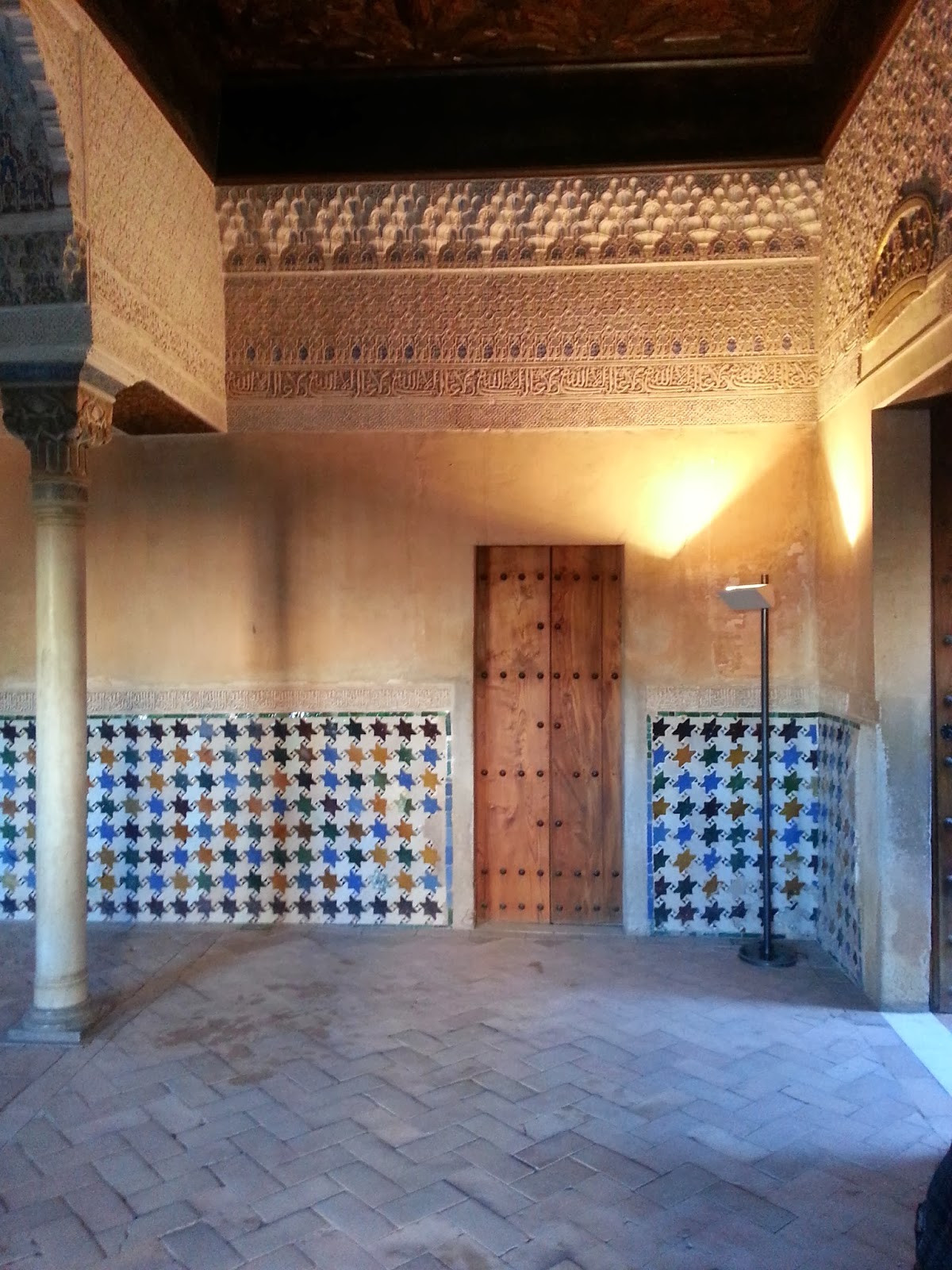
I spent more time than I ever have in the past within the Mexuar (mashwar in the series) begun by Fatima’s father, Muhammad II in Sultana. Most of the tours had moved through and made it easier to take pictures. Warning: if you’re planning a visit to Alhambra any time soon, the morning tours make it almost impossible to get a shot anywhere without crowds moving through the space.  Try after 12pm. The Mexuar of today reflects the period of Fatima’s great-grandson Muhammad V, the hero of my next, Sultana: The Bride Price. Fatima did not live long enough to witness his ascendancy. During his extensive reign, Muhammad V had the opportunity to shape what we see. From the entryway with its 1362 frieze styled in Nashki cursive script to the poetry along the walls speaks of the majesty of one of the most illustrious sultans of the Nasrid Dynasty. I can’t go into why Muhammad V altered so much of his ancestors’ palace complex without ruining the plot of The Bride Price, but let’s just say he had great reason to celebrate and revitalize the site.
 
It is impossible to know how much alteration Muhammad V made to the chamber as it might have stood during the reign of his great-great grandfather Muhammad II. The differences between Moorish and Christian influences within the space can be found in the addition of the emblems of the Catholic Monarchs Isabella and Ferdinand to start. In Moorish times, the Mexuar’s floor was at a different height and there were two windows, with a central doorway and another facing west towards the citadel at Alcazaba, not four barred windows. At first glance it would appear as if the upper walls are stark, but closer observance reveals traces of blue and green pigments. Color is everywhere in Alhambra, especially where you least expect it. Unfortunately most of the luxurious tile work and the lantern lighting the cupola between the four pillars of the chamber are gone. In this room I imagined a scene of Sultana might have taken place, where Fatima’s husband Faraj received the governorship of Malaga (Malaka). A poem once adorned the walls of the Mexuar at the direction of Muhammad’s minister Ibn al-Khatib:

“…Muhammad, son of Abu l-Hajjaj (Sultan Yusuf I) built me, and thus is worthy of the truest and most genuine praise.
It is he whose skill – blessed be he – unites with constancy two opponents: generosity and courage...." 
From the Mexuar and its oratory, also redesigned by Muhammad V between 1363 and 1367, an open arch leads to an open space now called the Golden Chamber with its adjoining portico facing north of Alhambra. More on that tomorrow, as uploads of the pictures are painfully slow here. 

Ready for the cover reveals of the Sons of the Dragon novellas?

All three covers of the Sons of the Dragon novellas are ready. My cover artist, Mirella Patzer, did a stellar job as usual. It helps that we...