Showing posts with label Muhammad V. Show all posts

Friday, May 9, 2014

Meet the characters - Haziyya al-Riyad

HRH Princess Lalla Salma of Morocco,
inspiration for Haziyya al-Riyad
In Sultana: The Bride Price, the love of Muhammad V's life is not his future bride Jazirah, but a woman of Tuareg / Berber heritage from the Rif mountains of Morocco. Haziyya al-Riyad, whose name translates as "garden favorite" is a purely fictionalized character. The histories I have of Muhammad V don't mention another wife or any concubines by name, but it is likely he had some favored woman or women at his side as his Nasrid ancestors did. When I was writing, I imagined Muhammad as a young ruler seeking not only the pleasures of women in his life, but a companion with whom he could share his life. Haziyya is a strong character, among other strong characters, with a Berber father and a Tuareg mother whose cultural dress and beliefs she favors.    

The physical description of the character was inspired by a photo I had seen of the royal consort of Morocco, Princess Lalla Salma, who is from the capital at Rabat. The queen is a natural redhead; a small percentage of people of Berber descent in the north of her birthplace have red and blond hair. Berbers were part of the first wave of Muslim invaders that Spain faced in the eighth century. One of the most famous rulers of  the country, Abd al-Rahman I of the Umayyad dynasty (whom I'll talk about much more in the future) supposedly had blond or reddish-blond hair inherited from his Berber mother. One of the Berber dynasties I have featured prominently in the novels of the Sultana series are the Marinids, who ruled Morocco from 1248 to 1465. In Sultana: The Bride Price, the Marinids are key allies of Muhammad V.

The Tuareg are a Berber people, who have typically survived in a nomadic lifestyle ranging throughout the Sahara. They have lived in the region for centuries, surviving Arab and later colonial incursions, while maintaining a fascinating culture with enduring rituals. They are sometimes referred to as the 'Blue People' for their garments often dyed a deep shade of indigo, which then rubs off on their skin. The men of their tribes veil their faces, but the women do not. For several centuries, the Tuareg held beliefs in the spiritual properties of plants and animals, but with the advent of Christianity and Islam, those later beliefs have been incorporated.

The character of Haziyya al-Riyad embodies the pride of the Tuareg people and a Berber heritage. Learn more about her in Sultana: The Bride Price. 


Tuesday, April 22, 2014

Meet the characters - Muhammad V

At the same time as the Meet My Main Character theme had become popular on the blogs of other writers of historical fiction, I had planned to introduce the others in my cast of characters from Sultana: The Bride Price. Here's the hero of the novel, Sultan Muhammad V.

Rudolf Swoboda's "Portrait of Abdul Karim: The Mushni" (1888)
reminds me of Muhammad V. Courtesy of Wiki Commons
Readers of Sultana: Two Sisters while remember Muhammad as the only son of Sultan Yusuf and his former Christian slave, Butayna. At the abrupt end of his father's life, Muhammad came to the throne. The novel opens with him at fourteen months into his reign, where he is contemplating more than just the marriage offer made to his cousin Jazirah, which I talked about in a previous post. I imagine Muhammad's physical appearance as similar to this painting; he's dark-haired, a bit burly, always well-dressed, but saddled with a brooding personality.

As the eldest of the three sons of Yusuf, Muhammad faces turmoil within his harem. He's plagued by worry that his stepmother Maryam, the villainess of Two Sisters, is plotting against him along with the governors of his province. Since Yusuf did not officially name an heir before his death, leaving it to high ranking ministers to select Muhammad, his position is a little precarious. The continued rivalry between his mother Butayna and Maryam becomes dangerous, as each women develops factions for support within and outside the palace. Muhammad's been burdened by duty for so long that he can't even contemplate marriage to the woman he truly loves, a Berber concubine named Haziyya al-Riyad. Even more perplexing, Haziyya nor any other concubine in his harem has managed to conceive a son for him in years. Coupled with the fact that his future bride's father numbers among malcontents who wonder whether Muhammad's ministers made the right choice of an heir, he doesn't start off the novel in a very happy place.    

Muhammad is, as with most of my characters, based on the historical figure of Sultan Abu Abdallah Muhammad V of the Nasrid Dynasty, based within Granada's Alhambra. Born January 4, 1338, he ascended the throne when he was sixteen immediately after his father's death. In writing about him, I didn't have to dig too deep to imagine what life would have been like for a teenager to lose a parent - my father died when I was the same age. Luckily, I didn't have even one quarter of the responsibilities Muhammad would have faced at the time. As the new ruler of a kingdom slowly shrinking while the Castilians and Aragonese nibbled away at Granadine territory in the north and the Muslims of Morocco tried to influence Granada's politics and future, Muhammad needed counselors at his side. He relied upon two men from his father's reign in particular, each of whom play strong secondary characters, the ministers Ridwan and Ibn al-Khatib. But there comes a time in every young person's life when you want to step out from the shadows cast by the adults in your life, and Muhammad's experience wasn't any different.

He was one of the most enlightened rulers of Moorish Spain. He is largely responsible for the beauty within Alhambra that we are fortunate to see today. He ordered the construction of one of the best hospitals in fourteenth century Spain, the Maristan. When the Castilians under Enrique II began a relentless persecution of Jews, Muhammad welcomed them into Granada. He met or knew many of the famed scholars of the time, including Ibn Battuta who visited during Yusuf's reign and Ibn Khaldun, who would later serve as an ambassador to Castile on Muhammad's behalf. He regained much of the territory lost by his ancestors to other rulers, including a major victory at the port city of Algeciras in 1369. During his reign, he sired at least four sons and one daughter, leaving his kingdom and his heir poised to continue with great achievements.

How does my portrayal square with the real Muhammad V? The factual accounts of his life certainly influenced the events I've written about in The Bride Price, but historical fiction isn't just names, dates and places. It's about people. In the novel, Muhammad is shrewd beyond his years, but also a very suspicious young man who sees traitors hiding in every darkened corner. The sudden loss of his father shapes his perspective, as does his relationship with his mother, who as a Christian and a former slave, is viewed with some merited suspicion by others in the kingdom. When she exhibits very secretive behavior while insisting on her son's marriage to a traitor's daughter, Muhammad can't help but wonder whether his mother has his best interests at heart. I don't doubt the real ruler must have faced similar quandaries, not knowing whom to trust. Find out how the fictionalized Muhammad resolves his difficulties in Sultana: The Bride Price.                   

Thursday, November 28, 2013

The Public Alhambra: Comares Palace - Yusuf I & Muhammad V

While touring Alhambra, I met a nice couple from Greenwich and we fell to talking about this amazing monument. The wife asked who built Alhambra. That’s not such an easy question to answer, but I did explain how various rulers ordered construction on certain parts, later adapted or altered by their descendants. The Comares tower is one example. What we see today is the influence of two of the major rulers from the 14th century; Yusuf I, my hero in Sultana: Two Sisters, and his son with Butayna, Muhammad V.


There has always been a bastion at this particular spot of Alhambra, from perhaps even before the rule of Fatima’s grandfather, Muhammad I. Several scenes in the series take place in this hall; the return of Muhammad I’s body to Granada and the ascendancy of Muhammad II in Sultana; Fatima’s confrontation with her murderous, full-blood brother Muhammad III after the sudden demise of their father in Sultana’s Legacy; Yusuf I’s meeting with the rebel Marinid princes in Sultana: Two Sisters. The Comares tower became a likely backdrop for several momentous events in Alhambra and Granada’s history.


That the Comares tower definitively served as the throne room of Fatima’s relations comes from a poem inscribed within the central, north-facing alcove of the hall. The verses name the ruler in whose name the tower was built as Yusuf I and as such, either his chief minister Ali ibn al-Jayyab or that man’s successor, Ibn al-Khatib composed the words. They refer to the nine alcoves in the room as a group of constellations, with the central alcove as the most important because the monarch sat there:

“…My lord Yusuf, sustained by God, clothed me in dignity with robes of undeniable distinction, making me the throne of the kingdom (kursi mulk), the grandeur of which is born up thanks to the Light, the Seat and the Throne.”


Before entering the Comares tower at the north, there is a shaded arcade of eight pillars beneath arches, mirrored at the south end of the Court of Myrtles. Next is a hall referred to as Sala de Barca, for its boat-shaped ceiling. Muhammad V ordered its construction as an extension of the Comares hall, possibly dating to as late as 1367 because after that year, all further expansion at Alhambra in his reign bears the regal name he adopted after the Granadine recapture of Algeciras (al-Jazirah al-Khadra), al-Ghani bi-Llah, which means ‘he is who is satisfied by God.’ Fire destroyed the original ceiling in 1890.

I love the hidden spaces of Alhambra – actually, not really, since the authenticity of my series would be better if I could see everything – and the Comares hall obliges by having two doors, one leading up into the tower and another for the ruler’s private oratory. The imagination can run wild in this place, wondering about the intrigues that unfolded in the throne room.

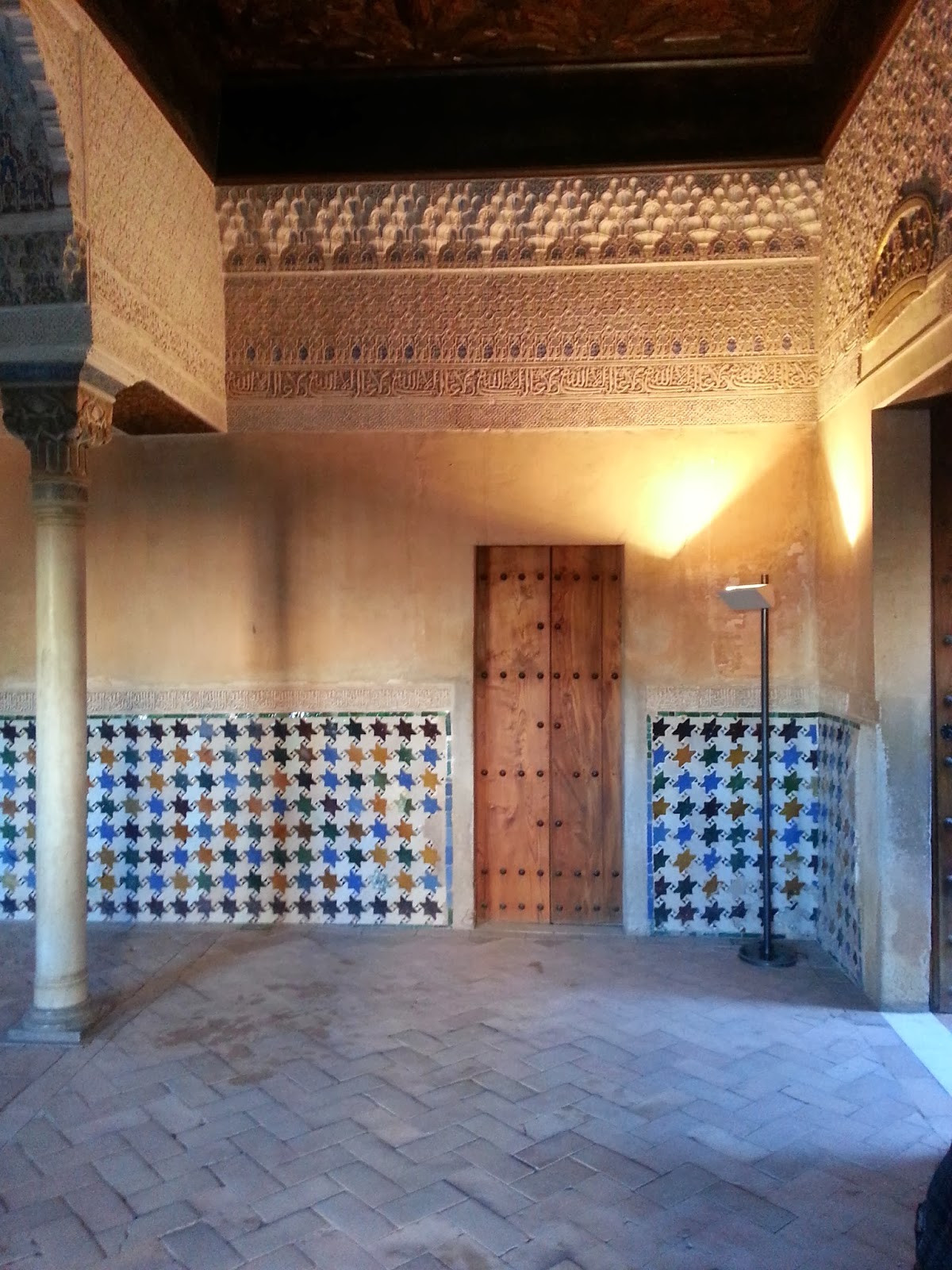
Muhammad V finished the work his father Yusuf I started on the Comares hall. Light streams into the room through the lattice in each alcove, illuminating a 16th century terracotta floor. At its center are ceramic tiles glazed in gold, blue and white. In the days of the Nasrid sovereigns, no one crossed this space because the 99 names of God in Arabic were inscribed here. I assume this significance is part of why the original floor is missing.


Since the rooms to the south were destroyed by Charles V, speculation also remains about what lay behind the façade. Was the space reserved for foreign dignitaries during their visits to Alhambra? Did the important ministers like Ali ibn al-Jayyab, Ibn al-Khatib or Muhammad’s faithful boyhood tutor Ridwan have rooms there? In Sultana: Two Sisters, I described the upper floors as being part of an extension of the harem, placing Butayna and Maryam’s chambers in the south end of the Court of Myrtles. I imagined them peering through the latticework at events unfolding outside the throne room. The likely position of the harem seems too small to have accommodated the rulers and their families over generations. Also, the modern access at the south end from the Court of Myrtles to Muhammad’s crowning achievement, the Court of Lions, did not exist during Nasrid rule. The Catholic Monarchs linked those two areas.


Next, I’ll wrap up with the last public space visitors can still see, the baths attached to what was once the great mosque of Alhambra, built by Fatima’s brother Muhammad III. I had hoped to also show pictures of the royal graveyard (rawda) where some of the monarchs like Muhammad II, his grandson from Fatima, Ismail I and Ismail’s son Yusuf I, were interred along with their illustrious matriarch, Fatima, but it appears conservation efforts are underway. I was fortunate to see some of the gravesites in an earlier visit. No bodies lie there. When the Nasrids lost Granada forever in 1492, they took the bones of their ancestors out of Alhambra. They may have reinterred them at Mondujar, where the last Sultana, Moraima, was buried. The gravestone of Muhammad II is in the Alhambra Museum in Charles V’s rotunda.

When I’m back in New York, I’ll share more about Alhambra, the private world of the Nasrid bath, harem and the summer palace.   


Happy Thanksgiving if you’re celebrating in the US.

Wednesday, November 27, 2013

The Public Alhambra: Muhammad V's Contributions - Part II

I haven’t found any reference for the name the Moors once gave the open-air courtyard of the Golden Chamber in Alhambra. The name derives from the 1499 gilded restoration of the room. A different passageway existed in Fatima’s time, possibly evidenced by an eastern-oriented doorway from the Mexuar. Many theorize that ambassadors and other dignitaries waited in the chamber to meet with the rulers of Granada. Of all the most common inscriptions incised along the walls of the Golden Chamber, this one is most repeated: “Victory only comes with God, the Powerful, the Wise,” a verse from the Qur’an.

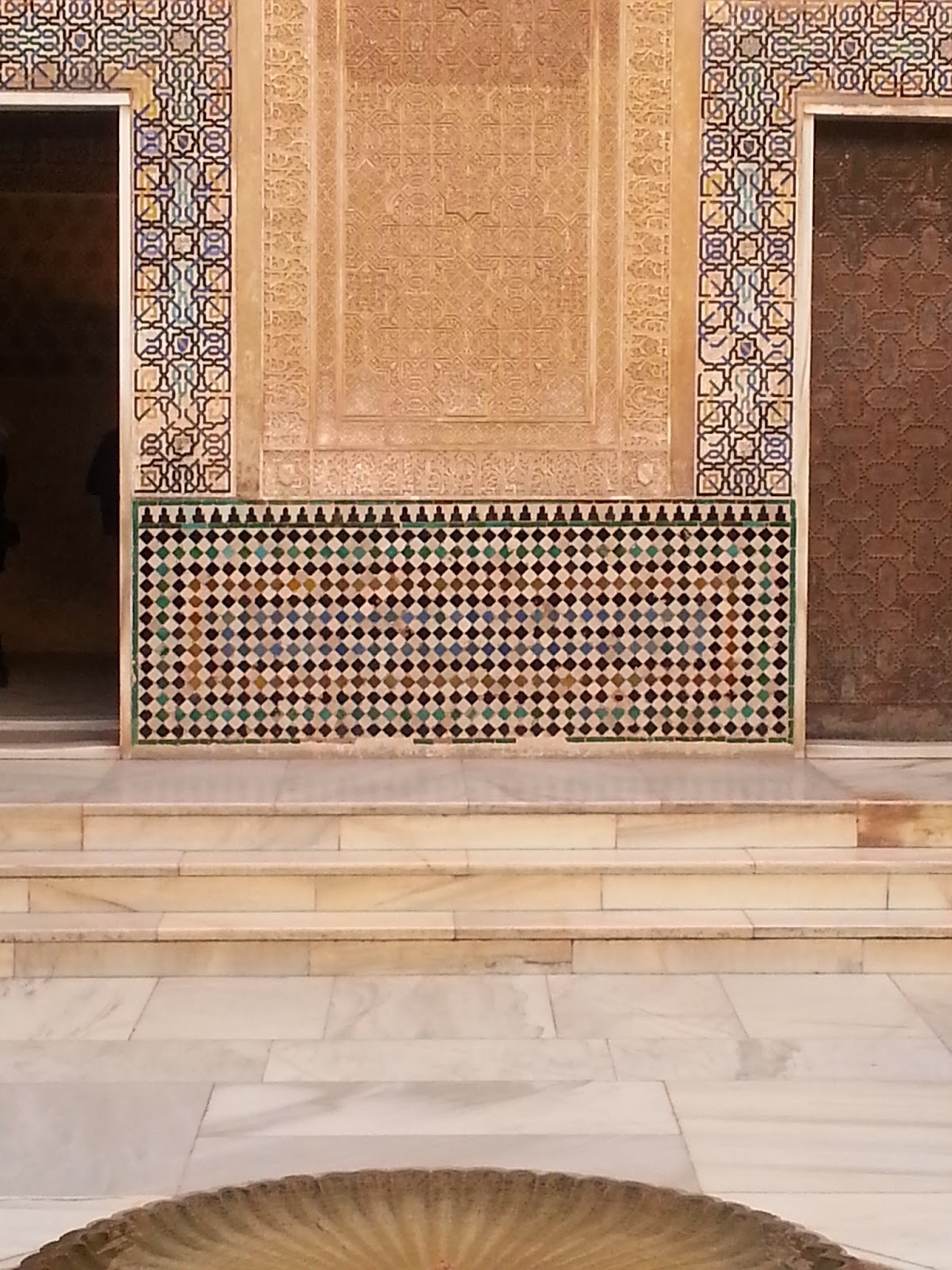
Muhammad V undertook some of the work evident in the hall between 1367 and 1369, to commemorate prominent victories over his enemies at cities like Jaen (Jayyan), Baeza (Bastah) and most importantly, Algeciras (al-Jazirah al-Khadra). In Moorish times, three windows rather than a central, north-facing one overlooked the city. Medieval visitors would have enjoyed an incredible view of the neighborhood of Albaicin (Al-Bayazin). To the south, the façade indicates two doors, but only one has ever been open to the public. On either side of the doors, a blessing is incised along with carved shells and pine cones. There are latticework windows above, which indicate an upper floor removed by the Catholic Monarchs. Through the Golden Chamber’s open door at the south, visitors enter the façade of the Comares palace via a right-angled corridor with arched alcoves.

I don’t why this section is called the Comares; there was a fortress-city at Qumarich held first by the Ashqilula clan, one- time allies of the Nasrids until Fatima married her paternal cousin Faraj in 1266. Fatima’s father regained Qumarich when he exiled his Ashqilula enemies, but I can’t think of any significance the territory held afterward. The name could also derive from Qamriyya for the stained glass windows, which once existed in the Comares tower, or from Qum`arsh, an Arabic term for “room or seat of the throne.” Whatever the source, Comares is one of the most spectacular spaces in an already stunning place.

At its center is the Courtyard of the Myrtles. At the north the Comares tower remains, but to the south the 1537 Palace of Charles V obliterated any rooms behind the façade. The southern portico has a central door forever closed and two more at the adjoining east and west walls, all topped by a row of eight windows covered by lattice and columns joined by arches above. There is a pool bordered by two series of myrtle bushes. The courtyard likely existed in Fatima’s time, but her grandson Yusuf I, father of Muhammad V, made changes that were not completed before Yusuf’s untimely death in 1354. Muhammad V finished his father’s restoration by 1370. On its eastern side, latticed windows front the courtyard and one door leads to the bathhouse built by Fatima’s son Ismail I. The western wall is its mirror image; through the southernmost door fitted along it, visitors can glimpse the path to the Mexuar that serves as the modern entrance. There are arched alcoves along both walls, some of which give access to other restricted parts of the palace. A poem composed by Ibn Zamrak, one of the ministers of Muhammad V described the courtyard:

“I am like a maidservant whose betrothed desire each other and to whom a crown and diadem have already been given; before me is the mirror, a pool upon whose surface my beauty takes shape.”
More on the Comares tower in the next post.

Tuesday, November 26, 2013

The Public Alhambra: Muhammad V's Contributions - Part I

Hola from cold but beautiful Granada and its famous Alhambra. I’m taking a much-needed break and enjoying my favorite place, which allows for the continuation of my post from last month about the complex as the characters of the Sultana series would have known it. Evidence of restoration is everywhere in Alhambra today, all geared towards the preservation of this beautiful monument. As a result, crowd control has also become stricter, but even this couldn’t lessen my enjoyment. It is a little sad to see some of the further deterioration that Alhambra has undergone since I first visited exactly 12 years ago this week, but the site remains inspirational. This morning as I walked down and up the Sabika hill again, two things struck me. One, medieval Moors must have been in incredible shape, because that hill is a killer, or they had very sure-footed horses. Two, the extensive view of the Granadine plain afforded a natural vantage point for the location of Alhambra and ensured its defense for almost seven centuries.

I spent more time than I ever have in the past within the Mexuar (mashwar in the series) begun by Fatima’s father, Muhammad II in Sultana. Most of the tours had moved through and made it easier to take pictures. Warning: if you’re planning a visit to Alhambra any time soon, the morning tours make it almost impossible to get a shot anywhere without crowds moving through the space.  Try after 12pm. The Mexuar of today reflects the period of Fatima’s great-grandson Muhammad V, the hero of my next, Sultana: The Bride Price. Fatima did not live long enough to witness his ascendancy. During his extensive reign, Muhammad V had the opportunity to shape what we see. From the entryway with its 1362 frieze styled in Nashki cursive script to the poetry along the walls speaks of the majesty of one of the most illustrious sultans of the Nasrid Dynasty. I can’t go into why Muhammad V altered so much of his ancestors’ palace complex without ruining the plot of The Bride Price, but let’s just say he had great reason to celebrate and revitalize the site.
 
It is impossible to know how much alteration Muhammad V made to the chamber as it might have stood during the reign of his great-great grandfather Muhammad II. The differences between Moorish and Christian influences within the space can be found in the addition of the emblems of the Catholic Monarchs Isabella and Ferdinand to start. In Moorish times, the Mexuar’s floor was at a different height and there were two windows, with a central doorway and another facing west towards the citadel at Alcazaba, not four barred windows. At first glance it would appear as if the upper walls are stark, but closer observance reveals traces of blue and green pigments. Color is everywhere in Alhambra, especially where you least expect it. Unfortunately most of the luxurious tile work and the lantern lighting the cupola between the four pillars of the chamber are gone. In this room I imagined a scene of Sultana might have taken place, where Fatima’s husband Faraj received the governorship of Malaga (Malaka). A poem once adorned the walls of the Mexuar at the direction of Muhammad’s minister Ibn al-Khatib:

“…Muhammad, son of Abu l-Hajjaj (Sultan Yusuf I) built me, and thus is worthy of the truest and most genuine praise.
It is he whose skill – blessed be he – unites with constancy two opponents: generosity and courage...." 
From the Mexuar and its oratory, also redesigned by Muhammad V between 1363 and 1367, an open arch leads to an open space now called the Golden Chamber with its adjoining portico facing north of Alhambra. More on that tomorrow, as uploads of the pictures are painfully slow here. 

Ready for the cover reveals of the Sons of the Dragon novellas?

All three covers of the Sons of the Dragon novellas are ready. My cover artist, Mirella Patzer, did a stellar job as usual. It helps that we...