Showing posts with label Sultana. Show all posts

Sunday, December 3, 2023

Time flies when you're having fun, or writing novels.

It's been a tremendous twelve months. A new job and health issues have impacted my writing time, but I'm still at it, trying to wrap up the second half of Vlad Dracul's story in Order of the Dragon - Book Two. 

For those who've read my novels in the past, you know that I'm an obsessive researcher and try to get the details right. That's meant scrapping my novella about Vlad's eldest son Mircea, whose actions can't entirely be separated from his father's own, and requiring me to narrow my focus to the other two sons, Radu and Vlad the Monk. What about Vlad Dracula, you may ask? The inspiration of the vampire legend? He appears in each of my novels and novellas about his family, almost as a force of nature, but I have very specific reasons for choosing NOT to make him a protagonist in a third novella. One, Vlad Dracula has been done to death in fiction. The reality of his life AND the myth of his being a vampire (thanks ever so much, sarcastically, to Bram Stoker, as the real Vlad Dracula was WAY MORE INTERESTING). There's nothing new or nuanced that I could reveal about his experiences. Besides, I find his father and brothers equally interesting figures whose stories deserve to be told. Two, if you want to read one of the best portrayals of him in fiction, get a copy of C.C. Humphrey's Vlad: The Last Confession. You will be immersed as I was.

Since 2005, I've been blessed to share a friendship and partnership with author Mirella Patzer, but this year marked the culmination of a novel we've been working on since 2019, when she visited me during one boiling August here in Barbados. As I'm known for writing fiction set in Europe's Middle Ages, this novel, tentatively titled The Ordeal of Alice Clifton, is a complete departure from that period and takes readers to 18th century Philadelphia in the aftermath of the American Revolution. The novel tells the story of a real-life figure, the mulatto slave Alice Clifton, who endures the attentions of a brutal man related by marriage to the first Speaker of the House of Representatives. His rapes result in her pregnancy, and when her daughter dies, she is accused of infanticide. But for her trial and the intervention of the then leader of the Philadelphian government, Benjamin Franklin, no one would ever know Alice Clifton once existed. Mirella and I are shopping around for a home for our great collaboration. I'll announce future publication plans here. 

By the way, Mirella's newest novel, Her Secret Legacy, just made its debut on December 1. If you weren't aware of her or her work, why not get started with a copy of her latest today.  

My attention to detail in the Sultana series of novels also offered another chance to collaborate with an author whom I admire; David Blixt. He may not remember, but I first encountered him while attending a session he conducted at the Historical Novel Society's 2013 conference entitled, "Swordplay and Its Influences on Culture." Read all about his session here - and you can ask me sometime why I wore a dress and sandals to an event where attendees handled real swords! Little did I know back then that five to six years later, David and I would work together on an anthology, We All Fall Down: Stories of Plague and Resilience (2020). His contribution made me cry. It's rare for an author's words to have such a profound effect on me. If you haven't read his stories, get started here today. And not just because he and I are working on a project partly set in Moorish Spain that you'll want to read! More details about our work in the future.

Most recently, that obsession with Moorish Spain's history also led a doctoral student at the University of Granada to contact me regarding her thesis, which focuses on the sultanas of Granada, but also examines the importance of historical fiction. I'm a prodigious reader and history buff and will admit, I struggle with those who say they don't enjoy reading or find history dull. It was a great honor to share some correspondence with the student and to reflect on the questions she asked. As I told her, Moorish Spain has lived on in my head and heart for over thirty years. Ever since I was a freshman in college, where I first discovered the Islamic presence in Europe and how it was eradicated. I also related to the student that historical fiction's best service to history and historians is to evoke interest in the past, keeping history alive and relevant to our experiences today, and firing the imagination of readers. My motivation for continuing to write. 

Sunday, January 31, 2021

Happy Birthday, Baby! Sultana, Book 1 is officially ten years old

Time flies when you're having fun. Hard to believe this book baby is a whopping ten years old! I can still remember everything that led to its publication and all that has come afterward.
 

Years of obsessive research among dusty library stacks and across the internet. The first perfect night in Spain where not even the frigid temperature or an undercooked meal of paella and sour sangria could have ruined my initial sight of Alhambra Palace from the Cuesta de Los Tomasas. Long hours of writing and revisions, coupled with some key advice from my critique group, whose members helped shaped Sultana into the novel it is today. The support of the best writing friends and the encouragement of readers, who responded so well to the book, they inspired me to write a series. Speaking and reading engagements at libraries and presentations for the Historical Novel Society.  The first offer of translation and the others that followed. The delight on my mother's face as I shared my love of Moorish Spain during our stay in Granada - her approval and praise after she read the book meant the world to me.

All that has occurred because of a novel some said would never be successful once self-published. Still amazes me.

In celebration of its tenth anniversary, I'm pleased to offer Sultana for FREE all month long starting February 1, exclusively.

Tuesday, July 14, 2015

New cover for the Spanish translation of Sultana

I was finally able to accomplish one of many projects I had wanted to do for some time; update the cover art of the e-book only, Spanish translation of Sultana. As often happens, life got in the way, but it's finally finished. One of the most helpful tools I've found is the Adobe Creative Cloud, which offers a year's access to the Adobe suite of Photoshop, InDesign, Illustrator, etc. Even better, there's now an added feature called Adobe Stock where subscribers can download high-quality royalty-free images such as those found at Dreamstime, Fotolia and Shutterstock. The following images captured elements of what I was looking for in a new cover:

1. 

2. 

To which I added one purchased years ago from another site:

3. 

Over time, I've learned to manipulate images with GIMP, PhotoScape and Paint.net; each of these is photo editing software, which has its strengths and drawbacks when you're interested in cover design. I love them because they're free tools that anyone with the patience and perseverance to try can work with; trust me. I haven't attempted any design work in PhotoShop as yet, but expect my learning curve to soar dramatically once I give the program a try.

In Paint.net, I cropped image #1 of the Muslim woman praying and saved it as my foreground image. Then I opened up picture #3 of the Lion Court of Alhambra in GIMP and saved that as my background. I can't say enough great things about the GIMP program, as it allows you to select just the sections you want and copy / paste or layer them into another photo.

Later, I opened a second window with the woman's image and selected just her figure. Then I layered my selection in the Lion Court photo, scaling it so she would appear in the foreground in the most naturalistic pose. Saving this new image as the base, I went back to Paint.net and selected one of the beautiful gold borders from image #2. Then I elongated these borders at the top and bottom of the new image:


Afterward, in PhotoScape, I added the text. Finally, I used GIMP again to clean up areas around the figure, where blotches had occurred.
   
And here's the final version:

Tuesday, October 28, 2014

Novel translations: From the translator's perspective

Can you guess the name of this title
translated into Spanish? I'll give
you one good guess.
Back in the summer, I mentioned looking into translations of the Sultana series. I'm so pleased and proud to announce that not only is the translation of the first novel complete, but I'm equally thrilled to have my translator Maria J. Manzano as a guest on the blog today. Maria worked so hard on the novel, which is now available via Kobo, Barnes and Noble and Apple, and her translations reads beautifully. For now, she had agreed to work with me on promotional materials in Spanish, but she will also translate more books in the series. Here's Maria's perspective on the process:


Lisa: Thank you so much for agreeing to do a guest post. Is this your first foray into translation work?

MARIA: No, it is not. I started working as a freelance translator a year ago and I have already carried out some major translation assignments. One of them was an historical essay on presidential assassinations and assassination attempts on the life of American presidents and the other assignment was a novel by an American author. I have also carried out other minor projects for some Spanish translation agencies both in English and French.

Lisa: What drew you to the opportunity to translate?

MARIA: I worked as a secretary for an international financial firm for a number of years so when I decided to explore other fields and to change careers I thought that working on the translation sector would be compelling.

MARIA J. MANZANO

Lisa: What are some of the most rewarding and challenging aspects of language translation?

MARIA: I think it is the fact that when you work with a language that is not your mother tongue you encounter some difficulties. The fact that you are capable of overcoming these difficulties it is extremely gratifying. I also enjoy the research that sometimes I need to conduct to carry out my work.

Lisa: Are you an avid reader?

MARIA: I am indeed. I read French and English literature as well as historical books and biographies in Spanish, French and English but at present I read mostly works in both French and English.

Any advice you would give to anyone looking into providing language translation.

MARIA: Above all, I strongly believe that a translator should be very inquisitive and have a natural thirst for knowledge, being a fervent reader will allow him or her to have a good command of the language too. Also a translator should be very consistent throughout the translation of the text and as close to the original document as possible. From my point of view that is essential. It is also worth considering to get specialized in some types of texts since a translator is not necessarily good at all kind of texts. That is usually the case. He or she may feel particularly confident when working on literary texts but not so much when working on legal texts, whereas others may be very skillful at the translation of technical texts. I personally enjoy working on financial and economic texts too. 

Thank you so much, Maria, for making this experience so rewarding and I look forward to our future projects.

Thursday, June 19, 2014

Update on the Sultana series

The official release date of Sultana: The Bride Price is Monday, June 30. At long last and after a little consternation and probably too much nit-picking, I'm finally able to offer the title as an ebook. The paperback will be ready one month later.

One of the changes made in Sultana: The Bride Price was the exclusion of the historical events from my Author's Note. For readers who are really interested, those details will be posted on The Sultana Series page of my website by June 30. The link will be embedded in all digital versions. While many readers have told me how much they appreciated the details of the past, the historical notes for The Bride Price added nearly twenty pages to the manuscript. In addition to the histories of the main characters, I've included information on the prominent ministers who served Muhammad V, as well as some of his descendants. Unfortunately for the Moors, the reign of Muhammad V was the last glorious heyday of the Nasrid dynasty before family squabbles began the downward spiral. The Nasrids proved too adept at destroying themselves from within, long before the intentions of the Catholic Monarchs Isabella and Ferdinand came to fruition. That doesn't mean I plan to end this series on a somber note, but if there's been one consistent theme of each book, it has been that the bonds between family are very important and when those bonds begin to fray, disaster often follows. 

In other series' news, I'm looking into Arabic, German, and Spanish translations of each novel, and I've finished the outline and character list of Sultana: The Pomegranate Tree, which I'll start writing in 11 days. Wow, 11 days. The next novel makes a huge leap of eight decades from the time of Muhammad V to the tail end of the fractured reign of his grandson, Muhammad IX. Not that interesting stuff didn't happen in that 80 year  span - the problem is that too much happened! More importantly, no truly strong queen of the caliber of Fatima, Butayna or Maryam has come down through history for me to write about her in those times. Four books down, two more to go! Once the series is done in 2015, all six books will be bundled as an ebook only. Lastly, I'm working out a snafu with Amazon whereby Sultana has not been available as a paperback sold directly from their website since September 2013. Resolving this hasn't been fun, but I'm nothing if not persistent.

Thursday, April 17, 2014

Sultana: free for 3 days on Kindle

Sultana: A Novel of Moorish Spain (Sultana: Book 1) is free on Kindle April 17 - 19. Get caught up on the series before the fourth book, Sultana: The Bride Price, makes its debut in May. http://authl.it/16r.

In thirteenth-century Moorish Spain, the realm of Granada is in crisis. The union of Fatima, granddaughter of the Sultan of Granada, with the Sultan’s nephew Faraj has fractured the nation. A bitter civil war escalates and endangers both Fatima and Faraj’s lives.

All her life, Fatima has sheltered in lavish palaces where danger has never intruded, until now. A precocious child and the unwitting pawn of her family, she soon learns how her marriage may determine her future and the fate of Granada. Her husband Faraj has his own qualms about their union. At a young age, he witnessed the deaths of his parents and discovered how affluence and power offers little protection against indomitable enemies. Guilt and fears plague him. Determined to carve his own destiny, Faraj struggles to regain his lost inheritance and avenge his murdered family.

Throughout the rugged frontiers of southern Spain, the burgeoning Christian kingdoms in the north and the desert states of North Africa, Fatima and Faraj survive ruthless murderers and intrigues. They unite against common enemies bent on destroying the last Moorish dynasty. While Fatima and Faraj establish a powerful bond, the atmosphere of deceit creates opportunities for mistrust and tests their love.

Snippet:

Aisha smiled again, but it seemed sad. “Hush now, child, listen well. Understanding shall come. Even when you must do what others command, never forget the power of your own reasoning. One day, your husband may rule your body, he may even come to rule your heart, but your mind is and always must be your own, where none but you may rule. Promise me that you shall never forget these words.”

Fatima swayed slightly. Her throat hurt, but she whispered, “I promise.”

She returned Aisha’s intent stare, for the first time, unafraid. Aisha’s eyes glistened like gems in the lamplight.

“This is the only measure of advice I can give you, Fatima. You must learn the ways of men, as I have. Do not trust in men alone. Love, be dutiful and respectful, but trust yourself and your instincts first. They shall always guide you rightly.”

Saturday, February 1, 2014

Flash sale - Sultana series, each book at $0.99, only on Feb. 1

Sultana: The Bride Price, book four of the Moorish Spain series, makes its debut in spring 2014. Just for one day, get caught up on the first three ebooks in the series, each 99 cents,only on February 1. That's right, all three books in the series including; last summer's release, Sultana: Two Sisters, are on sale today only at my website and all the retailers below

Sultana, book one
iBookStore
Barnes and Noble's Nook
Kobo
Smashwords


Sultana's Legacy, book two
Amazon
iBookStore
Barnes and Noble's Nook
Kobo
Smashwords


Sultana: Two Sisters, book three
Amazon
iBookStore
Barnes and Noble's Nook
Kobo
Smashwords


Friday, December 20, 2013

$25 Amazon gift card giveaway: About Sultana

UPDATE: THIS PRIZE HAS BEEN CLAIMED, CONGRATULATIONS TO THE WINNER!

Time for the third giveaway, especially for readers of Sultana, the first in my Moorish Spain series set within Granada's Alhambra. As with the previous contests for On Falcon's Wings and The Burning Candle, I'm offering a $25 Amazon gift card by email to one reader who can correctly answer 3 random questions about the novel - the gift card can be used for anything you may purchase from Amazon. This giveaway is open internationally. 

Here are the rules:

  • First person to provide the correct answers to all 3 questions in a comment on this blog post OR my Facebook page wins. 
  • Leave your email address in the comments section to be considered in the drawing. 
  • This contest doesn't require you to follow The Brooklyn Scribbler blog or Like my Facebook page (although I'd love it if you did!), but you must have read the book. 
Now, questions from Sultana.


In Sultana (2011), the heroine Fatima is a Moorish princess wed to her paternal cousin Faraj, a move which precipitates a civil war between Fatima's family and their former allies.

1. What is the Moorish name of the city where Fatima grew up?

2. Which of the following men is Fatima's father?

A. Muhammad I
B. Muhammad II
C. Muhammad III

3. What is the name of Fatima and Faraj's firstborn son?

Thanks for playing and good luck! Next chance to win will be on Friday, Dec. 27 , for readers of Sultana's Legacy. Merry Christmas! 

Tuesday, November 26, 2013

The Public Alhambra: Muhammad V's Contributions - Part I

Hola from cold but beautiful Granada and its famous Alhambra. I’m taking a much-needed break and enjoying my favorite place, which allows for the continuation of my post from last month about the complex as the characters of the Sultana series would have known it. Evidence of restoration is everywhere in Alhambra today, all geared towards the preservation of this beautiful monument. As a result, crowd control has also become stricter, but even this couldn’t lessen my enjoyment. It is a little sad to see some of the further deterioration that Alhambra has undergone since I first visited exactly 12 years ago this week, but the site remains inspirational. This morning as I walked down and up the Sabika hill again, two things struck me. One, medieval Moors must have been in incredible shape, because that hill is a killer, or they had very sure-footed horses. Two, the extensive view of the Granadine plain afforded a natural vantage point for the location of Alhambra and ensured its defense for almost seven centuries.

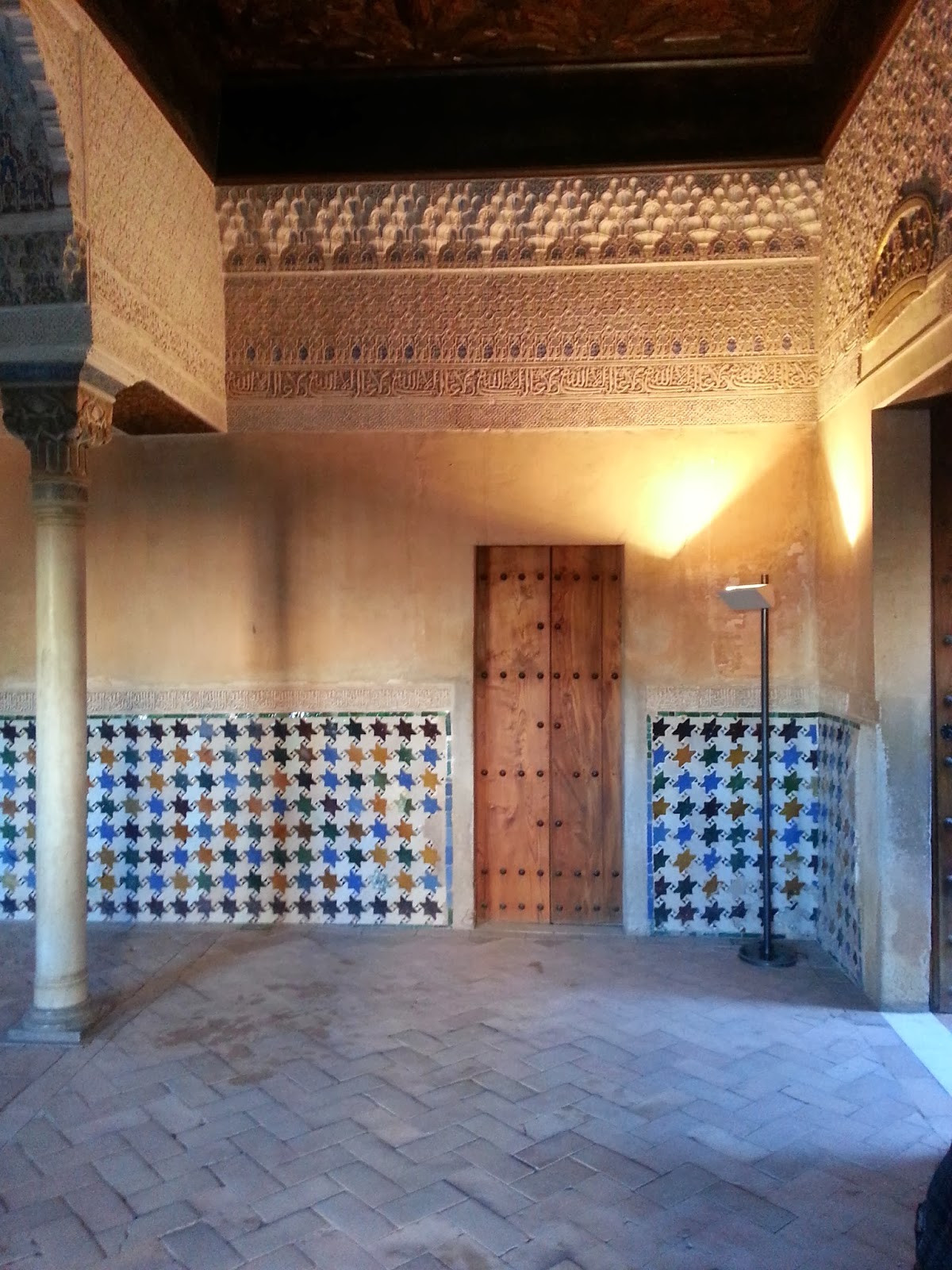
I spent more time than I ever have in the past within the Mexuar (mashwar in the series) begun by Fatima’s father, Muhammad II in Sultana. Most of the tours had moved through and made it easier to take pictures. Warning: if you’re planning a visit to Alhambra any time soon, the morning tours make it almost impossible to get a shot anywhere without crowds moving through the space.  Try after 12pm. The Mexuar of today reflects the period of Fatima’s great-grandson Muhammad V, the hero of my next, Sultana: The Bride Price. Fatima did not live long enough to witness his ascendancy. During his extensive reign, Muhammad V had the opportunity to shape what we see. From the entryway with its 1362 frieze styled in Nashki cursive script to the poetry along the walls speaks of the majesty of one of the most illustrious sultans of the Nasrid Dynasty. I can’t go into why Muhammad V altered so much of his ancestors’ palace complex without ruining the plot of The Bride Price, but let’s just say he had great reason to celebrate and revitalize the site.
 
It is impossible to know how much alteration Muhammad V made to the chamber as it might have stood during the reign of his great-great grandfather Muhammad II. The differences between Moorish and Christian influences within the space can be found in the addition of the emblems of the Catholic Monarchs Isabella and Ferdinand to start. In Moorish times, the Mexuar’s floor was at a different height and there were two windows, with a central doorway and another facing west towards the citadel at Alcazaba, not four barred windows. At first glance it would appear as if the upper walls are stark, but closer observance reveals traces of blue and green pigments. Color is everywhere in Alhambra, especially where you least expect it. Unfortunately most of the luxurious tile work and the lantern lighting the cupola between the four pillars of the chamber are gone. In this room I imagined a scene of Sultana might have taken place, where Fatima’s husband Faraj received the governorship of Malaga (Malaka). A poem once adorned the walls of the Mexuar at the direction of Muhammad’s minister Ibn al-Khatib:

“…Muhammad, son of Abu l-Hajjaj (Sultan Yusuf I) built me, and thus is worthy of the truest and most genuine praise.
It is he whose skill – blessed be he – unites with constancy two opponents: generosity and courage...." 
From the Mexuar and its oratory, also redesigned by Muhammad V between 1363 and 1367, an open arch leads to an open space now called the Golden Chamber with its adjoining portico facing north of Alhambra. More on that tomorrow, as uploads of the pictures are painfully slow here. 

Friday, November 8, 2013

Sultana's featured today at The Fussy Librarian

The Fussy Librarian
Historical fiction | Fiction
Servant of the Gods by Valerie Douglas
$3.99Average Rating: 4.3 out of 15 reviews.
Buy Now:
Orphaned as a child, Irisi became a mercenary to survive. Captured by the Egyptian army and made the spoils of war, she finds herself forced to fight in the ring for entertainment. In a desperate attempt to regain her freedom she throws herself on the mercy of the Gods, only to discover that her fate is written in prophecy...
 
The Fussy Librarian
 
Historical fiction | Fiction
Sultana: A Novel of Moorish Spain by Lisa J. Yarde
$3.82Average Rating: 4.0 out of 67 reviews.
Buy Now:
   
Book #1 of the Sultana series. In thirteenth-century Moorish Spain, the realm of Granada is in crisis. The union of Fatima, granddaughter of the Sultan of Granada, with the Sultan’s nephew Faraj has fractured the nation. A bitter civil war escalates and endangers both Fatima and Faraj’s lives. All her life, Fatima has sheltered in lavish palaces where danger has never intruded, until now. A precocious child and the unwitting pawn of her family, she learns how her marriage may determine her future and the fate of Granada. Her husband Faraj has his own qualms about their union. At a young age, he witnessed the deaths of his parents, and discovered how affluence and power gives little protection against indomitable enemies.
 
The Fussy Librarian
 
Romance-historical | Fiction
My Highland Love by Tarah Scott
$3.99Average Rating: 4.4 out of 28 reviews.
Buy Now:
 
How does a woman explain to her betrothed that she murdered her first husband? Shipwrecked in the Scottish Highlands, American heiress Elise Kingston quietly plans revenge for the deaths of her daughter and the brother who sacrificed his life to save her. When Marcus MacGregor, Marquess of Ashlund, returns to his Highland home to discover a stunning American woman has been taken in by his clan, his attraction is instant and he resolves to make her his -- no matter what secret she's keeping. Elise is shocked by her need for Marcus and, too late, discovers that her feelings make him a target of her enemy -- a man powerful enough to destroy even a Scottish nobleman. This is a second edition. First Edition published by Silver Publishing.
 
The Fussy Librarian
 
Romance-historical | Fiction
The Virtuous Ward by Karla Darcy
$4.99Average Rating: 4.5 out of 43 reviews.
Buy Now:
  
If you love Downton Abbey and Jane Austen you’ll love The Virtuous Ward! This is book #5 in the Sweet Deception Regency series that brings you the adventures of the gentlemen of the ton who are members of Sweet’s Racing Club and the women they love. Lord Maxwell Kampford has kept his ward in seclusion but now must sponsor her in society in order to marry her off. Unsophisticated and trusting, Amity is set up by Max's jealous fiancée to fail. Max is confounded by the loyalties of the girl who seems to champion every orphaned and abused animal and turns his bachelor household upside down. Will he discover love or let this charmer get away?

Thursday, October 10, 2013

The Public Alhambra: Fatima's Perspective in Sultana - Part I

The Sultana series introduces readers to the real-life Moorish heroine Fatima, her husband Faraj and the rest of their family, all members of  the Nasrid clan, the last native Muslim dynasty in Spain. Sheltered from her youth within Granada's Alhambra (al-Qal’at al-Hamra), Fatima married Faraj, a paternal first cousin to her father Muhammad II in 1266 when she was between the ages of eight and twelve. Faraj was ten years older than his young wife. She died in her early nineties on February 26, 1349. Her husband preceded her in death some twenty years before, in February 1320. During Fatima's long years, she would have witnessed alterations to the complex of palaces, barracks, industrial and commercial quarters, mosques and baths at Alhambra. Although raised as a princess within the harem, Fatima did not remain hidden behind those walls. She would been familiar with all parts of the public domain her grandfather, father, brothers, son and grandsons ruled. From the dank, lowliest dungeon in Alcazaba to the delicate beauty of the summer palace at Alhambra, the Generalife, Fatima would have seen it all.


From the time her paternal grandfather Muhammad I occupied the site of Alhambra in 1237, thirteenth-century visitors and occupants of the site would have entered and left through its main medieval gate, along a course no visitors to Alhambra can see today. Referred to as the Puerta de Las Armas today, the precursor of this gate rose above what is now a neglected cobblestone path, permanently closed to all except Alhambra researchers. The route would have granted access to the complex for visitors from the north via a bridge over the Darro (Hadarro) river, and from the west up a hill, which the Moors called the Sabika. The gate connected with one of the oldest parts of Alhambra, its Alcazaba (al-Quasaba), which has existed since at least the ninth century during the first two centuries of Moorish rule over southern Spain.

As the most fully excavated portion of the complex, Alcazaba was the citadel of Alhambra, where the barracks of the officers and sentries existed in the shadow of a watchtower Fatima's grandfather built, the Torre de la Vela. This squat tower affords one of the best views of Granada, if you're willing to undertake a climb up the spiral stair inside to reach the top. Alcazaba was a construction of the Zirid period in Granada, during which Muslim rulers and their Jewish viziers developed the foundations of the citadel Fatima would have been familiar with in her lifetime. During his forty-year reign, Muhammad I enlarged Alcazaba by adding the Torre de la Vela. He provided water access for his men via a canal into which the Darro flowed. Water allowed for the addition of a cistern and bath. More than soldiers lived at the barracks of Alcazaba. The foundations of the excavated buildings indicate they would have accommodated families. But this is was not just a location where Granadine warriors gathered with their wives and children, enjoying meals and music beneath the stars at the end of a long day.


At the western end of Alcazaba, at the base of the Torre de la Vela, the sultans held their prisoners; captives for ransom and subjects who had fallen into disfavor. Unfortunates consigned to the cell descended via a ladder into a conical-shaped room with a trapdoor that left them no means of escape. Fatima would have been unable to escape their cries. In later years, when her full-blood brother Muhammad III poisoned their father and threw the man's servants into this dungeon, a warden took pity on them and offered the occupants some bread. When Muhammad III found out, he had the warden's head cut off and ordered it held over the trapdoor, dripping blood on to the prisoners, so that they could "have something to drink" in his words. During Muhammad III's reign, he also resided on the second storey of the Torre de la Vela at times.

Moving from the west, in the thirteenth-century a makeshift marketplace bounded by a precinct wall and a small ravine separated Alcazaba from the administrative areas of Alhambra. The northern boundary wall allowed visitors and residents to pass from this space, but it's impossible to know the thirteenth-century version of what preceded the sixteenth-century Patio de Machuca, which now occupies the west of the so-called Mexuar, or council area. Part of the reason some think the Mexuar was the council chamber likely comes from one tile in the room, which reads "Do not be afraid to ask for justice, for you will find it." Today, this space is where most visitors to Alhambra are invited to enter the palace. It's believed the foundations of a ministerial body developed during the reign of Fatima's father Muhammad II, perhaps prompted by what he had seen of the Castilian rudimentary parliament, the Cortes, during a visit to Seville in  December 1273. His council, the Diwan al-Insha, included some of the most preeminent men of Granada who served as secretaries, and heads of departments. A thirteenth-century lantern of stained glass once caught the sunlight filtering into this room. North of the Mexuar is a room designated as an oratory, retaining a wall inscription, "Do not be negligent. Come to prayer." The oratory opens up to a northwestern view of the Darro and the Albaicin neighborhood  known from Moorish times as al-Bayazin.

Later, I'll have more the public spaces Fatima would have been familiar with from the reign of her father, including what is now called the Hall of Ambassadors and the Court of Myrtles, the Partal buildings from the time of brother Muhammad III, the towers of her half-sibling Nasr I and the summer palace her son Ismail I built on an incline overlooking Alhambra.

For more, check out this virtual walking tour of Alhambra from Saudi Aramaco World.

Thursday, February 7, 2013

Chasing an elusive past to make up the perfect story

Since deciding on the future of the Sultana series and realizing I wanted to write about the last family to rule Moorish Spain from beginning to end, I needed to bridge a huge gap between the events of the first to the last book. Sultana: Two Sisters came out of that necessity, as it picks up with the grandson of my protagonists in Sultana and Sultana's Legacy and focuses on the influence of his two wives in the history of Muslim Spain. While researching the historical figures, I came across the most perfect story line for the follow-up. Only someone who writes about the past can understand this serendipitous moment; the confluence of full-blown details from verified sources and an author's desire for a compelling plot. OMG! It's like getting the best birthday-anniversary-holiday present ever! Or, maybe that's just my take on it.

Without giving too much away about the events that unfold in Two Sisters, during the reign of Yusuf I of Granada, his younger brother Ismail allegedly had his eye on the throne. The extent of Yusuf's mercy meant Ismail and his small family, including young children, went to jail. At least they weren't beheaded. Trust me, the Nasrid family were not the most forgiving bunch. Years later, when Yusuf's son Muhammad gained the throne, he sealed the family breach by marrying his first cousin, Ismail's daughter. And they lived happily ever after! Right? Trust me, I wouldn't be excited about this new novel if they had. As if an arranged marriage between this pair wasn't enough, there were also enemies within Granada plotting to take Muhammad's crown and Spanish Catholics encroaching daily on an ever-shrinking Moorish kingdom.  

In outlining the new work, I'm considering several aspects of the history. Within a marriage of convenience, can two people who have no reason to trust each other learn to do so? How do the sins of their respective fathers influence the relationship that develops? Where would the loyalty of Muhammad's new wife lie, with an embittered father or a husband who looks at her with more suspicion than lust? This particular story has it all - intrigue, murder, a bloody coup, and I suppose some "harem sex" - hope that will keep my recent blog visitors who seem to like searching those keywords happy.

What doesn't the story have?

I've struggled with a name, for starters. After weeks of searching for historical fiction titles online, some variations appeal like, "Sultana: A Heart Divided", "Sultana: The Summer Queen" or "Sultana: The Bride Price" - ETA: my good friend Anita helped me decide on the latter. It shouldn't surprise you how much thought I give to the title of a book. For instance, Sultana's Legacy reflects the somewhat tarnished but noble heritage it's heroine Fatima and her family leave to the next generation of the Nasrids. Sultana: Two Sisters pertains to  the strong bond of friendship and a secret, shared heritage between two future rivals.

While I know some intimate details about the main character, her marriage to Muhammad and how his dynastic troubles put her life and their infant son at risk, etc., guess what I don't know? Her @#$%^&* name. I am an obsessive researcher when it comes to writing about the Moorish period and even if every fact does not make it into the finished novel, at least the names, dates and historical events are accurate. Imagine how annoying it must be not to have one source mention this woman's name. So, what do I do? In the grand tradition of writers of fiction everywhere, I'll just have to make it up.

Monday, December 31, 2012

Bring on 2013!

Not that 2012 wasn't a great productive year, personally and professionally. Most goals were attained but a few are still elusive. There's just something about a new year; a new start, beginnings, hopes and prospects. The top things I'm anticipating for next year include:

Mid-year, the third in my series on Moorish Spain, Sultana: Two Sisters will be published. The penultimate draft is going through the critique group, whose members have provided incredible and encouraging feedback. I'm also happy to announce the next title in the series is underway (more on that in 2013) with plans for a total of six books on this topic through the next two years, spanning the history of the Nasrid Dynasty as rulers of Granada.

Audio book versions of On Falcon's Wings, Sultana and The Burning Candle are coming! Each title is currently in production through Audiobook Creation Exchange. The wonderful voice talent of audio book narrator and actress Sherill Turner, voice actress Maureen Boutilier and bilingual voice artist Laurence Krambule will bring the medieval period in England, Spain and France to life in these stories. Each of the narrators provided a perfect audio sample of the respective work, so I'm excited about listening to final versions by the end of winter.

Last but definitely not least, the Turkish translations of Sultana and Sultana's Legacy will be available from Istanbul publisher Beyaz Balina Yayinlari. Something about this bit still feels surreal. Yes, I've read that signed contract a few times. As part of it, the publisher will provide some free copies of the translated works. Do you think I have enough time next year to learn to read in Turkish?

I wish everyone an amazing and inspired New Year. May all your goals for 2013 be fulfilled!

Sunday, July 22, 2012

Thanks for a great two years

Today marks another important anniversary for me in a two-year journey of self-publishing. With five thousand copies sold (5,007 to be exact) and earnings totaling just over 12K, the last 24 months have exceeded my expectations at times. The bulk of revenue and associated sales comes from Amazon, specifically through Kindle, which accounts for 89% of earnings. While Amazon has played a huge role for which I'm exceedingly grateful, the coming years will find me trying to break into other markets and extend my reach beyond Kindle. If I have any regrets, it's that I haven't learned everything about self-publishing. Can't deny the gift of perspective.

There are so many people who've helped me along the way and deserve special mention. Anita Davison, whose brilliant story-telling and seven years of continued friendship guided me to Anne Whitfield's dedicated critique group. The group's brilliant members, like my dear friend Mirella Patzer, and Rosemary Morris, helped shape my manuscripts into works that readers have found worthwhile. Other critique groups led me to the naturally talented Gemi Sasson and Sheila Lamb, who've both embarked on their own stellar self-publishing journeys. Participation in ABNA contests earned the friendship of Kristen Wood, a great YA author. Social media tools have led to long Skype chats with Jeanne Kalogridis, whose books I've admired for years. I'm especially grateful to book bloggers like Tara Chevrestt and Deb Gaynor for being incredibly supportive.

I would have never reached this point without the generosity of readers, especially those who have written kind emails with their thoughts about the books. To Cristina, Jen, Beverly, Kathleen & Rae, Julia, Cxandra, Veronica, Deb and Tay, your passion and interest makes all my efforts worthwhile. 


Wednesday, May 23, 2012

Sultana Book Launch Party - Planning

Less of a book launch, more of a celebration of the signing of the Turkish deal on the two books in the series. To date, I've sold 2,678 copies of Sultana over 15 months, with an average rating of 4.3 / 5 stars on Amazon. Sultana's Legacy debuted in October 2011, with 973 copies sold and a rating of 4.3 also. While I'm 16 chapters into the next in the series, Sultana II: Two Sisters, this summer seems like a great time to take a break from the writing and celebrate the books. Why didn't I do this before when the books first came out? Didn't think of it, but now I am. It will be a 2-hour after work / evening event this July since family commitments take me to Wales and Barbados in late summer.

Since this is my first such event, I'm learning like everything else that's new, easy to do if you're willing.

Location, location: Does your book have a setting like mine that lends itself to the location? I've scouted seven locations between downtown Manhattan and south of 70th Street, with Moroccan or Spanish decor, as both books are set in Moorish Spain. Also cost is an important consideration. My total budget is a couple hundred; won't break the bank but will ensure a nice evening.

Entertainment: Food, music, and other entertainment give attendees an incentive to stick around. A private lounge with food, drinks and entertainment (typically a belly dancer) are included at six of the eight venues I'm considering, but the other two also offer a space I can decorate with personal touches. Think rose petals and citrus peels strewn on table tops, votive candles or tea lights. Also, a very gracious friend is offering her talents as a henna artist for the evening.

Books for sale: Assuming that not every attendee has read your book, the party seems like a perfect place to sell copies. Thanks to CreateSpace, I have a dozen free copies of both books, which will be available for discounted sale and signing throughout the evening. I also have business cards and bookmarks with the URLs for the books on Amazon, Barnes & Noble and my website.

Swag: Gotta thank everyone who showed up, right? I found the perfect little beaded organza bags to fill with a few items for all party guests. One lucky attendee will leave at the end of the evening with a Kindle Fire and another will each receive a signed paperback copy of each book.

Have you ever planned a book launch party? Are there any great ideas you can share?

Ready for the cover reveals of the Sons of the Dragon novellas?

All three covers of the Sons of the Dragon novellas are ready. My cover artist, Mirella Patzer, did a stellar job as usual. It helps that we...